
Lock forming machine is an essential piece of equipment in the air duct manufacturing industry. The multi-function lockforming machine for sale in Guigong Machinery can make seven different types of seam profiles, adding a "single flat seam" function to the standard six-function configuration. This machine can create a variety of seam shapes, meeting diverse requirements for joining, splicing, and corner-connecting thin sheet metal. This universal lock former is designed to process galvanized steel sheets with thicknesses ranging from 0.5 mm to 1.5 mm.
Whether you are establishing a duct fabrication workshop or expanding an existing production line, selecting the right machine starts with three questions: Which profiles do you need? What materials do you process? What production capacity must the machine support? Contact us with your specific requirements can make a quick quotation.
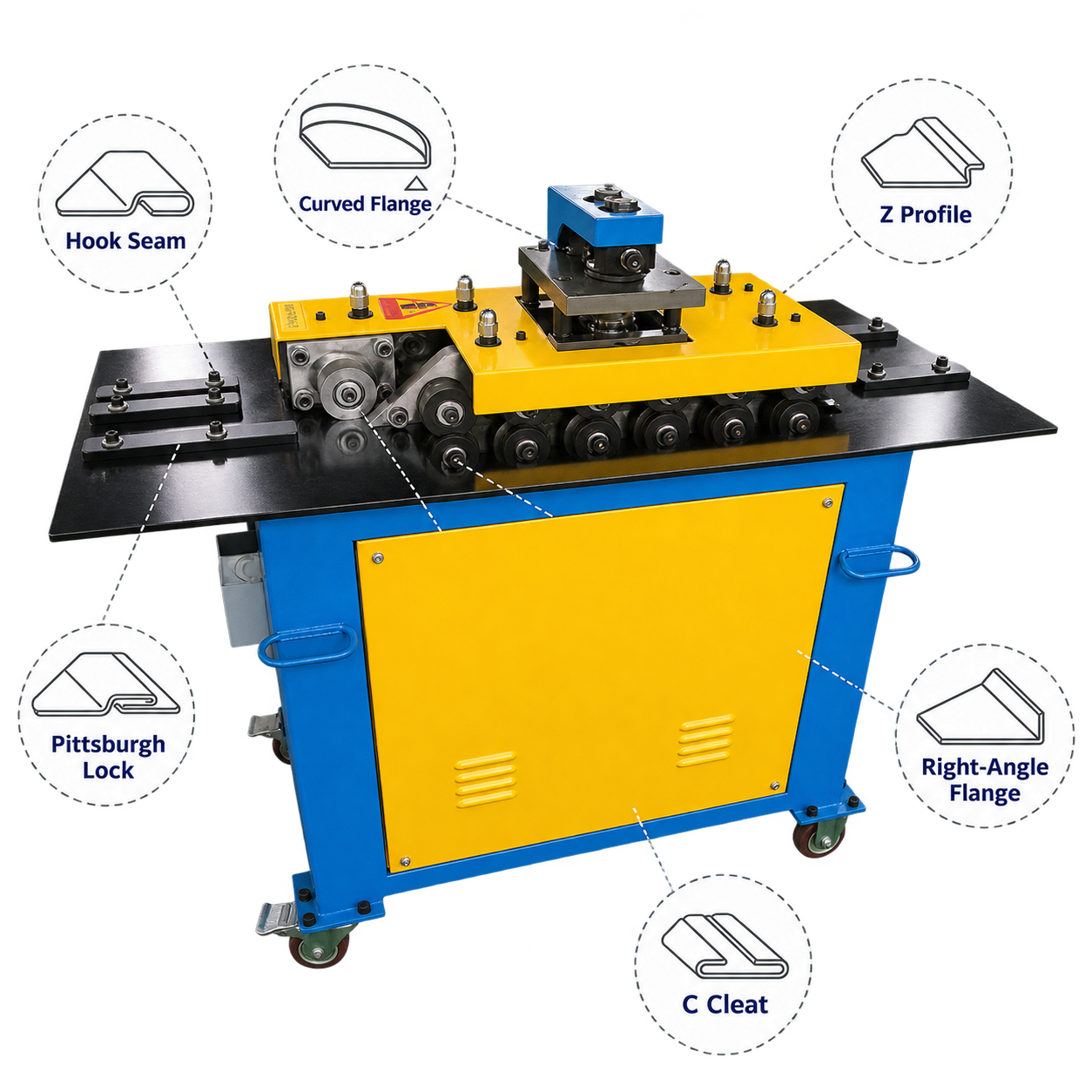
Lock forming machine, also known as lock former, pittsburgh lockformer machine, can form sheet metal edges into profiles used to assemble air ducts and related fittings. For workshops producing different duct components, a Multi-Function Lock Forming Machine offers the flexibility to create several connection profiles using one machine, depending on the installed roller sets and attachments.
This equipment is used in HVAC duct fabrication and general sheet metal work. Available configurations can include Pittsburgh lock, double seam, drive cleat, S-cleat and right-angle flange forming. The exact combination varies by model, so buyers should confirm the supplied profiles before ordering.
A lock forming machine uses a series of forming rollers to progressively shape the edge of a metal sheet. The resulting profile allows the sheet to connect with a matching edge or component during duct assembly. Its primary task is edge profile forming. Closing an assembled seam is a separate operation and may require a seam closing machine or other suitable tools. Equipment suppliers commonly list lock forming and duct seam closing machines as separate parts of the fabrication process.
For buyers, equipment selection should consider the full workflow, from sheet preparation through forming, folding, assembly and seam closure.
A Multi-Function Lock Forming Machine is particularly useful when a workshop regularly produces more than one type of duct connection. Instead of selecting equipment around a single profile, buyers can choose a configuration that covers several recurring fabrication tasks.
Different duct components require different edge shapes. A multifunction configuration allows a workshop to handle a broader mix of orders, provided the required tooling is included.
For example, manufacturer catalogues show configurations combining Pittsburgh lock, double seam, S-cleat and drive cleat functions, while other models include right-angle flange forming or additional attachments. These combinations are model-specific rather than standard across all machines.
Combining several forming operations in one machine can reduce the space needed for separate pieces of equipment. This can help smaller workshops organize material movement and keep frequently used forming tasks within a compact working area.
A multifunction lock former machine can support a workshop that handles varied duct fabrication work. When selecting the configuration, consider both current orders and likely future requirements.
For a workshop focused mainly on one profile at high volume, dedicated equipment may still be appropriate. For mixed production, a pittsburgh lockformer machine is worth evaluating because it can cover several tasks within one equipment purchase.
| Profile or function | Typical purpose | What buyers should confirm |
|---|---|---|
| Pittsburgh lock | Preparing edges for Pittsburgh seam assembly | Profile size and matching edge requirements |
| Double seam | Forming edges for compatible folded seam joints | Finished seam geometry and assembly method |
| Drive cleat | Producing cleat profiles used in compatible duct connections | Strip dimensions and whether slitting is included |
| S-cleat | Producing S-shaped connection profiles | Profile dimensions and tooling availability |
| Right-angle flange | Forming a flange along the sheet edge | Flange dimensions and applicable material capacity |
| Standing seam | Preparing edges for suitable standing seam applications | Whether the required tooling is standard or optional |
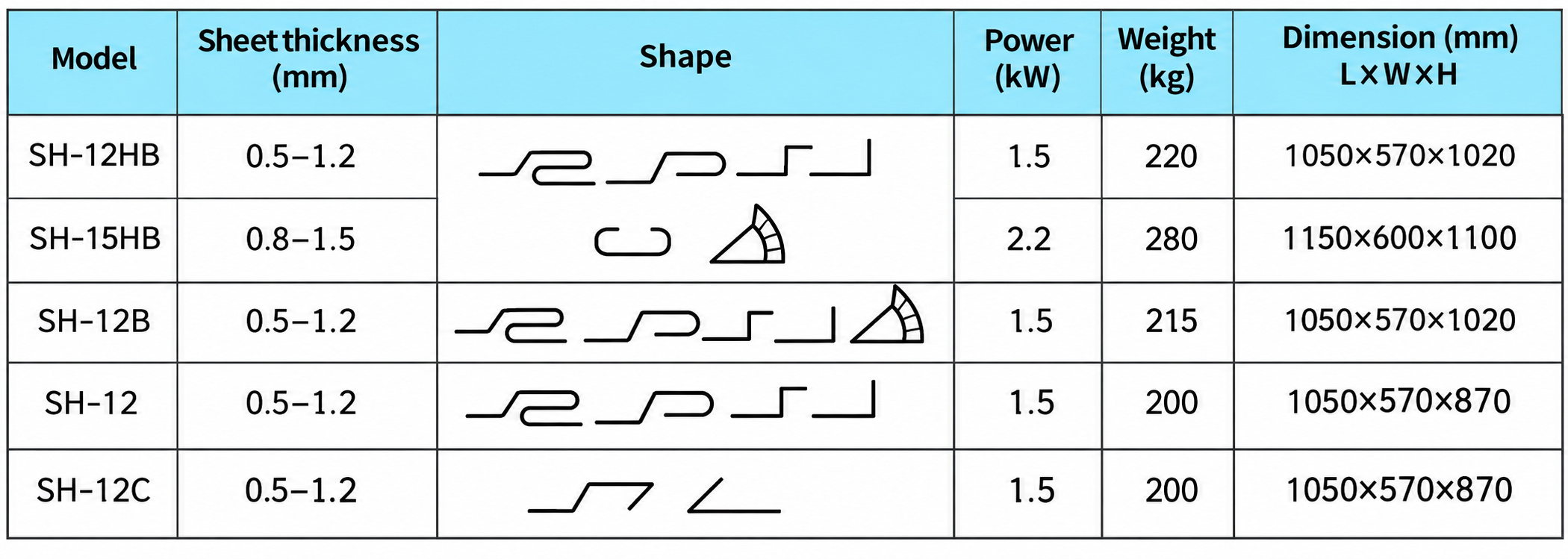
Manufacturers offer different combinations of these profiles. A profile drawing is a more reliable basis for comparison than a description such as “six-function” or “seven-function.”

Rectangular duct manufacturing is a principal application for this equipment. A suitable lockformer prepares connection edges on duct panels before they are assembled and closed. When specifying the machine, consider the profiles used throughout your duct system, including longitudinal seams and compatible transverse connection components.
Workshops producing transitions, elbows and other fittings may need several edge-forming options. A multifunction configuration can help accommodate this variety, although the ability to process a particular component depends on its geometry and the machine’s tooling and clearance.
Some lock forming equipment is also offered for applications involving chimneys, gutters and related sheet metal products. Suitability depends on the required seam design and machine configuration.
| Component | Main Function |
|---|---|
| Machine Frame and Base | Supports the machine and helps maintain stability during operation. |
| Forming Rollers | Progressively shapes sheet edges into Pittsburgh locks and other profiles, depending on the installed tooling. |
| Roller Shafts and Bearings | Supports the rollers and enables smooth rotation under forming loads. |
| Motor and Drive System | Supplies power and transfers motion to the forming rollers. |
| Feed Table and Guide Fences | Supports and guides the sheet into the correct forming position. |
| Adjustment Mechanisms | Allows forming settings to be adjusted according to the manufacturer’s instructions. |
| Electrical Controls | Controls machine operation, with protection features depending on the configuration. |
| Protective Covers | Helps restrict access to moving components. |
| Optional Attachments | Adds functions such as powered flanging or slitting when specified. |
Start with the actual material you process, including its type, thickness range and relevant grade. Do not assume that a capacity stated for mild steel also applies to stainless steel or another material. Ask for the permitted thickness range for your specific material and selected profile.
Both the minimum and maximum thickness matter. A machine selected only for its maximum capacity may not be the best match for the thinner sheets used in everyday production.
Profile names alone may leave room for misunderstanding. Send cross-sectional drawings, dimensions or clear samples of the required edges.
Confirm:
The number of forming stations and the number of available profiles describe different things.
Forming stations are the successive roller stages used to shape the material. Functions refer to the profiles or operations the machine can perform.
Manufacturer catalogues, for example, list machines with seven forming stations and several profile positions. Ask the supplier to explain both figures clearly. Neither number alone establishes the machine’s suitability or finished profile quality.
A forming speed figure does not tell you how many finished ducts a workshop can produce.
Output also depends on sheet preparation, loading, unloading, material support, profile changes and downstream assembly. When comparing lock forming machines, consider how the equipment will work with your existing cutting, folding and seam closing operations.
Before ordering, confirm the voltage, phase, frequency and electrical connection requirements.
Also review the machine dimensions, operating clearance, sheet support needs and maintenance access. These details should be settled before delivery so that installation can proceed smoothly.
If you are looking for a lock former machine for sale, start by identifying your material type, sheet thickness range and required profiles. A Multi-Function Lock Forming Machine for sale in Guigong can support different duct fabrication tasks when equipped with the appropriate roller sets and attachments.
When choosing a lock forming machine manufacturer, request profile drawings, forming samples and a clear list of included functions. Confirm the electrical requirements, maintenance support and spare parts availability to ensure the proposed equipment suits your workshop.
The lock forming machine price varies according to material capacity, tooling configuration, optional attachments and delivery terms. To obtain an accurate quotation, provide your material specifications, required profiles and delivery destination.
A lock forming machine shapes sheet metal edges into profiles used for assembling ducts and related components. In HVAC fabrication, common options include Pittsburgh lock and compatible cleat profiles, depending on the tooling supplied.
A multifunction model supports several edge profiles or related forming operations within one machine configuration. The included functions vary, so buyers should verify the tooling list rather than rely only on the advertised function count.
No. Pittsburgh lock forming requires the appropriate roller tooling. Confirm that the required profile is included and that its dimensions match your assembly requirements.
Only if the selected model, tooling and drive system are approved for the specified stainless steel material and thickness. Request written confirmation and a representative forming trial before purchasing.
Edge forming and seam closing are separate operations. A lock former prepares the profile, while final closure may require separate equipment or tools. Confirm the complete process with the lock former supplier.
The price depends on material capacity, included profiles, tooling, attachments, controls, service provisions and delivery terms. Request an itemized quotation so that different offers can be compared on the same basis.
Check application experience, profile drawings, representative forming samples, configuration details, maintenance documentation and spare parts support. Agree on acceptance criteria before placing an order.