
A Pittsburgh machine, also known as pittsburgh lockformer machine, can produce the pocket-shaped sheet metal edge used in Pittsburgh seam assembly. For duct manufacturers, its value lies in producing a consistent profile that accepts the matching flange and can be closed correctly during assembly.
The Pittsburgh lock former is available as a configuration of our multi-function lock forming machine. It forms the Pittsburgh pocket profile, while additional forming functions depend on the roller sets and attachments supplied.
The equipment supports the fabrication of rectangular HVAC ducts and compatible fittings. Selecting the right machine requires attention to more than maximum sheet thickness. Pocket geometry, material allowance, matching flange dimensions and the seam closing process all influence the finished result. Feel free to contact us for help at any time.
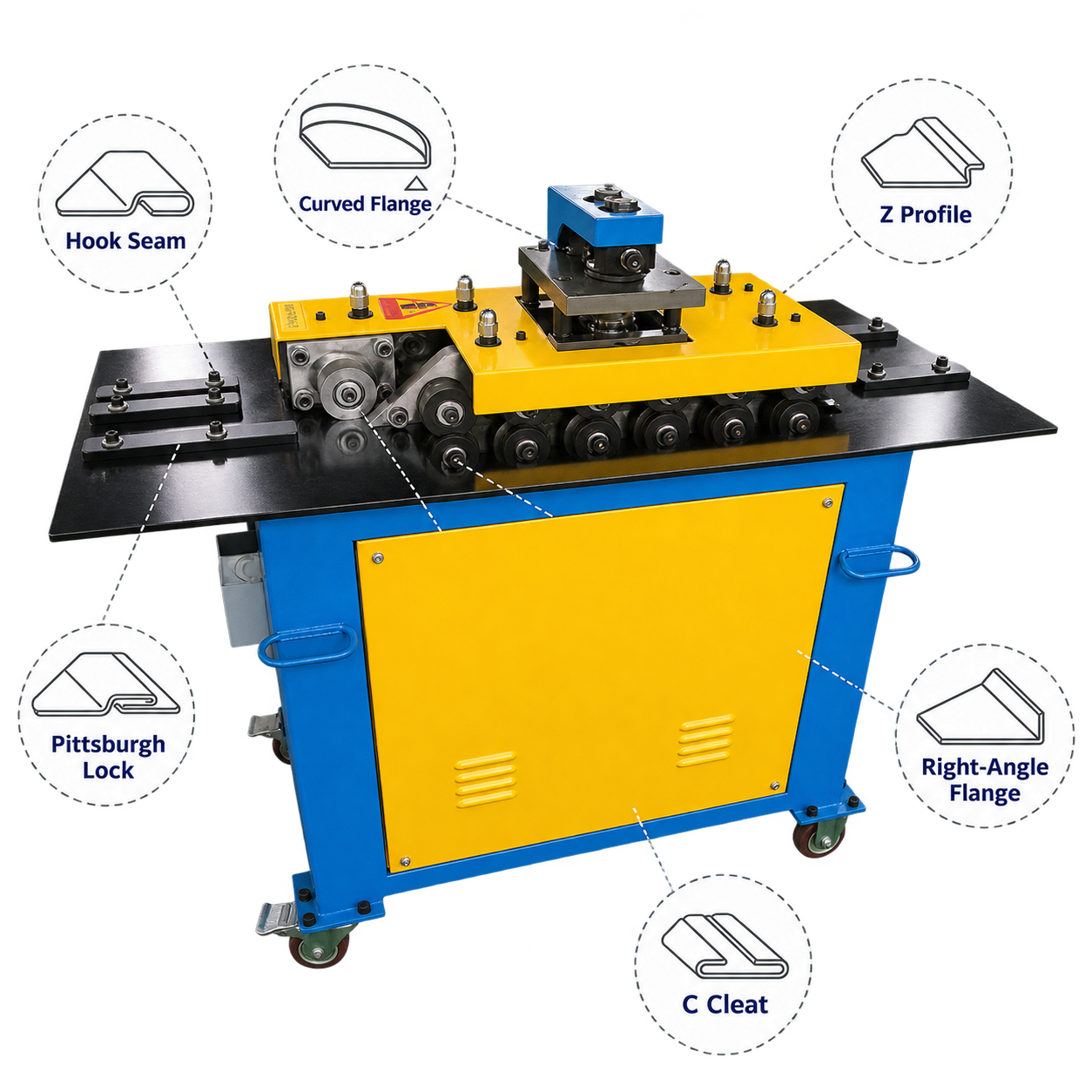
A Pittsburgh seam connects two prepared sheet metal edges. One edge contains a formed pocket and an extended closing lip, the other has a matching right-angle flange.
During assembly, the flange enters the pocket. The projecting lip is then folded over to retain the connection. Manufacturer documentation describes forming the pocket, inserting the flange and closing the edge as distinct stages.
This means the quality of the completed seam depends on three compatible elements:
The Pittsburgh lock forming machine prepares the profile. It should be selected as part of a complete duct fabrication process rather than treated as equipment that automatically completes the joint.

The machine feeds a prepared sheet edge through successive roller stages. Each stage progressively bends the material until the Pittsburgh profile reaches its intended cross-section.
For an approved material and tooling configuration, the lock can be formed in one pass through the roller sequence. However, this does not mean an assembled duct leaves the machine with its seam already closed. The matching flange still needs to be prepared, inserted and secured.
A typical production sequence is:
A Pittsburgh lock former is used to prepare longitudinal corner seams in rectangular duct fabrication. The selected pocket and mating flange must fit the sheet thickness and assembly method.
Pittsburgh profiles can also be used in compatible duct fittings. Manufacturer descriptions include applications involving straight and curved duct sections.
However, the ability to form an edge does not prove that every completed fitting can pass through the machine. Component clearance, blank shape and the stage at which forming takes place must be checked.
For an established duct shop, compatibility may be more important than adding extra functions. A replacement machine should produce profiles that work with existing flange preparation tools, assembly practices and closing equipment.
A profile may look acceptable but still be difficult to assemble if the pocket and mating flange do not match.
Ask the supplier for a dimensioned cross-sectional drawing showing the pocket, closing lip and recommended mating flange. These dimensions should relate to the intended material range.
The sheet needs to follow the intended entry path throughout forming. Inconsistent contact with the guide can change how much material enters the rollers and affect profile uniformity.
RAMS operating instructions specifically emphasize placing the material squarely against the entrance guide and maintaining contact with the guide during processing.
Thickness variation, damaged edges, burrs and sheet distortion can complicate forming and assembly. Incoming material checks should therefore be part of the production process.
Forming adjustments should follow the instructions for the specific machine. Manufacturer manuals may require paired adjustment points to be changed evenly; the procedure for one model should not be transferred to another. Avoid using a universal roller-gap value for different machines, profiles and materials.
The Pittsburgh pocket consumes part of the sheet width. This allowance must be included when calculating the blank size.
There is no single allowance that applies to every Pittsburgh lock forming machine. The required amount depends on the profile geometry and tooling. The mating flange also requires its own allowance.
For example, Mestek lists a particular Model 20 configuration with a 5/16-inch pocket and approximately one inch of material usage. These figures illustrate a specific configuration, not a universal cutting rule.
Before releasing production blanks:
This step is especially important when replacing a machine whose profile dimensions differ from the new equipment.
| Технические характеристики | Почему это важно | What to request |
|---|---|---|
| Material type and grade | Different materials impose different forming demands | Written approval for the actual material |
| Minimum and maximum thickness | Both ends of the range affect suitability | Capacity stated in millimeters for each material |
| Pittsburgh profile dimensions | Determines mating-part compatibility | Dimensioned pocket and flange drawings |
| Material allowance | Affects blank cutting and material consumption | Separate allowances for the two connecting edges |
| Forming speed | Influences processing time | Rated speed and a representative demonstration |
| Flange preparation | Determines how the mating edge will be produced | Details of included or separate equipment |
| Workpiece limitations | Affects small blanks, fittings and large panels | Minimum dimensions and clearance requirements |
| Electrical supply | Determines installation compatibility | Voltage, phase, frequency and connection requirements |
| Seam closing compatibility | Affects downstream assembly | Approved closure methods and equipment |
| Сервисная поддержка | Affects maintenance and downtime | Manuals, parts identification and support terms |
A gauge designation alone is insufficient for an international quotation. Request the thickness in millimeters, the material specification and the gauge convention used.
A Pittsburgh lockformer machine shapes a sheet metal edge into the pocket profile used in a Pittsburgh seam. It prepares the edge for assembly with a matching right-angle flange. The projecting lip must then be closed using an appropriate tool or seam closing machine to complete the connection.
A standard Pittsburgh machine primarily forms the pocket before assembly. Final seam closure is a separate task unless the supplied system specifically includes that capability. Confirm whether the quotation covers pocket forming, mating flange preparation and seam closing, or whether additional equipment is needed for the complete workflow.
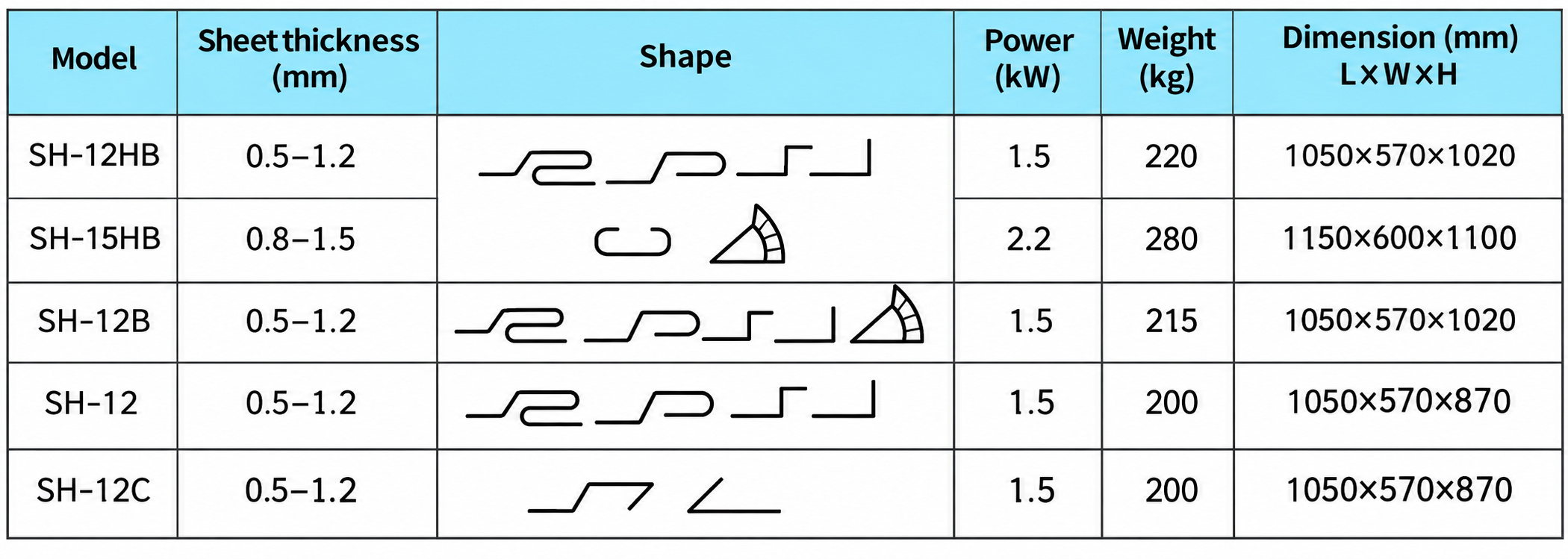
Thickness capacity depends on the model, tooling and material. Ask for both minimum and maximum values in millimeters, together with the relevant material specification. A capacity stated for mild steel should not automatically be applied to stainless steel, aluminum or another material without confirmation from the equipment supplier.
The required allowance depends on the actual Pittsburgh profile and tooling geometry. Obtain the supplier’s dimensioned drawing and confirm the pocket allowance separately from the mating flange allowance. Before batch cutting, assemble a trial component and check its finished dimensions, fit and closure using your intended production material.
Some machines can process specified stainless steel grades and thicknesses, but this capability must be confirmed for the selected configuration. Provide the exact material grade and thickness when requesting a quotation.
Possible causes include incompatible profile dimensions, an insufficient pocket opening, an oversized flange, burrs or material outside the approved range. Inspect both connecting edges before changing machine settings. Use the supplier’s drawings and troubleshooting instructions, and test adjustments on sample pieces before returning to normal production after the issue is resolved.
Leakage performance depends on fabrication quality, sealing provisions and the applicable project specification. Confirm the required sealing and testing procedures with the project documents, and assess the completed duct assembly rather than the formed pocket alone.
Price varies with material capacity, profile tooling, drive configuration, attachments and the scope of service and delivery. Check whether a flanging attachment, spare parts and closing equipment are included. Compare itemized quotations against the same requirements rather than judging value only by the initial price of the machine itself.
Request a trial using your specified material and representative workpiece dimensions. Inspect the pocket at several positions, assemble it with the intended mating flange and complete the closure. Check finished dimensions, surface condition and fit. Record the agreed acceptance criteria and retain approved samples or clear inspection records for reference.
Choose according to your actual production mix. A Pittsburgh-focused configuration may suit workshops primarily making that seam, while a multifunction machine can support additional profiles when correctly equipped. Compare Pittsburgh forming performance, changeover requirements, included tooling and service support rather than selecting solely by the advertised number of functions.
When comparing a Pittsburgh machine for sale, request evidence that it can produce and assemble your required seam.
A suitable Pittsburgh machine manufacturer should provide a clear configuration, profile drawings, material capacity and operating documentation. Ask for a forming video and samples made from representative material.
The Pittsburgh lock forming machine price depends on capacity, tooling, supplied attachments, controls, service arrangements and delivery terms. Compare quotations on the same scope, including whether flange preparation and seam closing equipment are included.
For broader profile requirements, a multi-function lock forming machine may be appropriate. Confirm each additional function separately while keeping Pittsburgh seam performance as the main acceptance requirement.