


Would Like the Latest Price?
Leave more about your requirements, like models, quantities, countries, etc.
Laboratory freeze dryer, also known as laboratory lyophilizer, is a small, precision low-temperature dehydration device specifically developed for scientific research experiments. It is a core precision device for ensuring the integrity, biological activity, and data accuracy of experimental samples. Unlike industrial mass-production freeze dryers, laboratory freeze dryers emphasize high precision, small batch production, fine-tunable parameters, and strong low-temperature stability. They are designed specifically for scientific research experiments, sample development, small-scale testing, and formulation optimization. Laboratory freeze dryers do not prioritize production capacity. Instead, they focus on parameter accuracy, sample protection, process adjustability, and operational stability. They are specialized equipment for drying and preserving heat-sensitive, easily oxidized, and microstructured samples in scientific research experiments. The laboratory lyophilizer equipment is compact, easy to operate, and highly adjustable, suitable for drying various precision samples such as bacterial strains, cells, serum, plant samples, extracts, and nanomaterials.


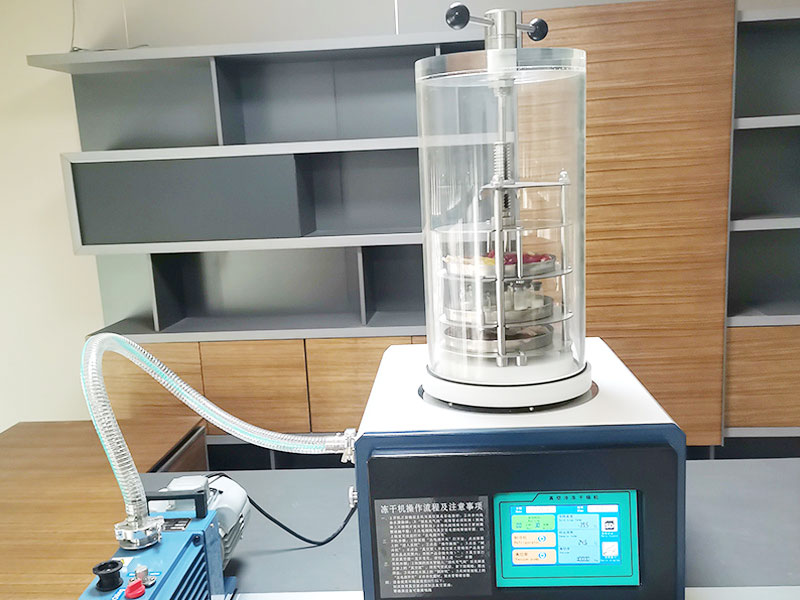

The standard type is the most basic tray-mounted benchtop freeze dryer. It features multi-layer stainless steel sample shelves, no capping mechanism, and no external bottle manifold interface. Samples are placed open in the tray for freeze drying.
Key features
Simple structure, easy maintenance and cleaning. All samples are dried uniformly on the chamber shelves, allowing for batch processing of bulk samples. After freeze drying, the vacuum needs to be broken to open the chamber and remove the samples. Internal sealing is not possible.
Suitable samples
Bulk research samples that do not require long-term sealed storage in bottles, such as soil sediment, plant leaves, roots and stems, slices of medicinal herbs, powders, gels, homogenates, and environmental sediments. Suitable for teaching experiments, material SEM sample preparation, and routine component pretreatment experiments.
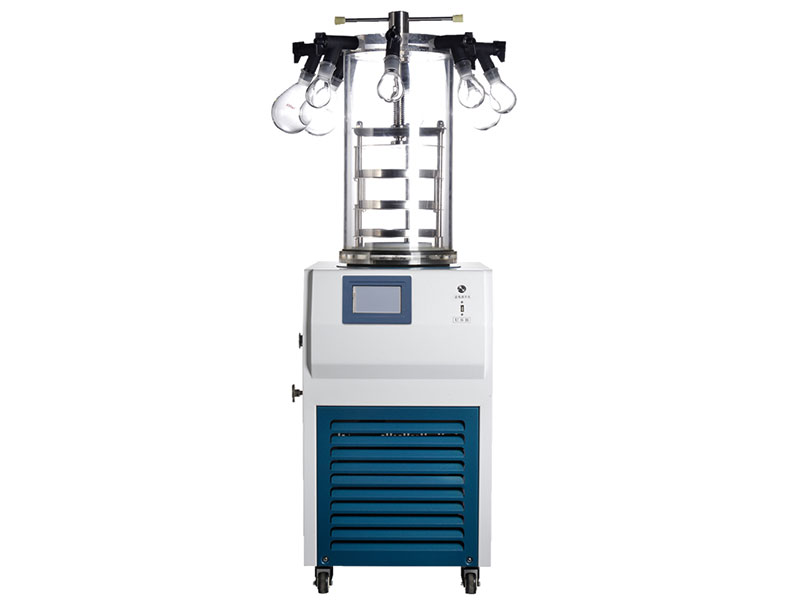
Based on the standard type chamber, the top cover adds a set of independent valve manifold interfaces, allowing connection to flasks, wide-mouth bottles, and centrifuge bottles. The internal tray shelves are also retained, the trays and external bottle hangers can operate simultaneously. Each manifold has an independent valve, allowing individual vials to be removed without shutting down the entire machine to release pressure.
Key Features
Dual-purpose machine. The internal tray holds bulk samples, while the external manifold suspends multiple individual sample vials. Each vial channel is independently controllable. Once a vial is freeze-dried, its corresponding valve can be closed and the vial removed, while the remaining samples continue the freeze-drying process. Samples within the vials undergo sublimation via ambient radiation, eliminating the need for shelf contact heating.
Applicable Samples
Multiple parallel comparative experiments, small samples with multiple formulations. Small quantities of multi-variety samples. Extracts, bacterial suspensions, and trace nanomaterials spirally frozen to the inner wall of an eggplant-shaped flask. Suitable for conducting multiple sets of control experiments under different conditions simultaneously.
The internal shelf is equipped with a liftable capping mechanism, and the tray holds vials with float stoppers. After freeze-drying, without breaking the vacuum, the mechanical mechanism directly presses down the partition to seal the vial stoppers tightly under vacuum, isolating them from air and moisture. The internal system also supports freeze-drying of open trays containing bulk samples.
Key Features
Vacuum In-situ Sealing. The vials are sealed in a vacuum environment. After removal, the vacuum inside the vial is maintained, effectively preventing moisture absorption, oxidation, and microbial contamination of active samples, making it suitable for long-term sample preservation.
Applicable Samples
Veneers containing bacterial strains, peptides, lyophilized protein powders, enzyme preparations, biological extracts, and research reagents. Samples requiring long-term viability after lyophilization. Suitable for bacterial strain preservation and small-scale development of biological reagents.
Combines the functions of both top-press and multi-manifolds types. The internal chamber has a lifting capping shelf for handling vials and internal vacuum sealing. The top cap also features a manifold bottle hanging interface for connecting flasks and wide-mouth bottles. The internal tray can also hold ordinary bulk samples. Three operating modes can be used independently or simultaneously.
Key Features
All-in-One Laboratory Model:
① Internal Tray: Open-top lyophilization of bulk samples.
② Internal Vial: Mechanical capping and vacuum sealing after lyophilization.
③External manifold bottle hanging system: Multiple sets of flasks can be freeze-dried independently, and each bottle can be removed individually without stopping the machine.
Applicable Samples
Laboratory samples are complex, including bulk materials such as soil and plants, vials for preserving microbial cultures and reagents, and parallel control experiments in flasks. Suitable for key laboratories with diverse research projects, varied sample types, and sufficient funding.
Leave more about your requirements, like models, quantities, countries, etc.
Scientific samples have thin cell walls and delicate microstructures. Rapid freezing can produce large ice crystals that pierce the tissue, leading to microstructural damage and distorted experimental data. The laboratory freeze dryer supports multi-stage gradient cooling, slow and uniform freezing to form fine, tiny ice crystals, ensuring the integrity of the sample’s cell structure. Meanwhile, it can meet the high-precision experimental needs of electron microscopy observation, porosity testing, and other similar experiments.
Many organic samples, polyphenol extracts, and microbial samples in scientific research are highly susceptible to oxidation, discoloration, and component degradation. Scientific lyophilizer equipment exhibits minimal vacuum fluctuations and maintains a stable vacuum level over the long term, preventing localized oxidation and component variations, and ensuring consistent experimental variables across multiple batches.
Scientific freeze-drying machine offers a narrower and more precise desorption temperature range, eliminating temperature drift. It accurately removes bound water without damaging heat-sensitive active substances, ensuring the stability of bacterial strains, enzyme activity, and protein activity.
Leave more about your requirements, like models, quantities, countries, etc.
Leave more about your requirements, like models, quantities, countries, etc.
Life sciences and microbiology research. Used for strain preservation, freeze-drying and preservation of bacteria and fungi, processing enzyme activity samples, and dehydrating cell tissues, replacing traditional low-temperature refrigeration and reducing the probability of strain degradation and contamination.
Agricultural and forestry plant research. Freeze-drying of plant leaves, roots, stems, and flower samples preserves active ingredients such as chlorophyll, flavonoids, and polyphenols for physiological indicator determination, plant stress research, and component analysis experiments.
Environmental monitoring research. Freeze-drying of sediment, aquatic sediments, and atmospheric deposition samples preserves organic matter and microbial community structure, ensuring reliable and accurate data.
New material development. Freeze-drying of hydrogels, aerogels, nanoparticles, and porous materials preserves their porous structure and prevents high-temperature collapse, making it an essential pretreatment method for SEM electron microscopy.
The working logic of a laboratory freeze dryer is to pre-freeze various water-containing experimental samples at low temperatures, completely solidifying the free and bound water inside the sample into ice crystals. Then, in a high-vacuum, sealed, low-temperature chamber, the ice crystals sublimate directly into water vapor and are condensed and discharged without melting into a liquid state. The equipment can achieve deep dehydration and drying of samples without damaging their microstructure, biological activity, or chemical composition. Experimental samples processed by the laboratory freeze dryer have a water content that can be precisely controlled between 1% and 5%, and can be stored at room temperature for extended periods. Freeze-dried samples can be rehydrated, and their original morphology, molecular structure, and biological activity remain largely intact, maximizing the accuracy of subsequent experiments, detection, and data analysis.
Oven temperatures above 60℃ directly damage plant active ingredients, microbial cells, protein structures, and porous material structures, leading to sample inactivation, component volatilization, and structural collapse. While vacuum drying operates at low temperatures, liquid water evaporation still occurs. Water evaporation stretches the sample’s microstructure, causing pore closure, tissue shrinkage, and component leaching, making it unsuitable for microscopic observation and precise component detection. Freeze drying involves low-temperature sublimation throughout the process, with no liquid water, no high temperatures, and no structural damage, making it the only pretreatment method that preserves the original structure and activity of the sample.
SEM requires samples with smooth surfaces, intact micropores, and no shrinkage or collapse. Ordinary drying causes fiber shrinkage, pore collapse, and a dense structure after moisture evaporation, making it impossible to observe the original microstructure under the microscope, resulting in severe data distortion. Freeze-dried samples undergo sublimation through ice crystal occupancy, forming a uniform porous structure internally. The surface morphology is intact, pores are clear, and the structure does not collapse, fully meeting the sample preparation standards for SEM. This is the standard pretreatment method for SEM testing of materials, biological, plant, and environmental samples.
Research samples are often tissues, gels, or high-viscosity extracts with uneven moisture distribution. Short-term pre-freezing only freezes the surface layer, leaving the internal moisture incompletely solidified. This can lead to melting, collapse, bubbling, and cracking during the freeze-drying process. Overnight slow pre-freezing ensures uniform overall temperature, fine ice crystals, and structural stability, guaranteeing the integrity of the morphology after freeze-drying.
The main causes are uneven sample thickness, inconsistent tray density, inconsistent pre-freezing time, vacuum fluctuations, and differences in sample moisture content. Scientific freeze-drying requires extremely high uniformity; excessively thick sample layers, stacking, or placement near the edge will all lead to different drying speeds, inconsistent moisture content, and significant differences in activity.
Common plant, soil, and material freeze-dried samples, sealed and dried, can be stored at room temperature for 1-3 years. Microbial and active protein samples are recommended to be stored at 4℃ in the dark and can be stably stored for more than 2 years. It is strictly forbidden to expose to moisture, direct sunlight, or leave them open; after absorbing moisture, the sample structure will rapidly deteriorate and cannot be used for experimental testing.
The cold trap temperature of a laboratory freeze dryer refers to the lowest cooling temperature of the condenser. Its core function is to capture water vapor generated by sample sublimation, quickly condense it into ice, and maintain a stable vacuum within the chamber. It is a core hardware parameter of the equipment, but lower temperatures do not necessarily mean better performance. Cold trap temperatures are mainly divided into three mainstream ranges, -55℃, -60℃, and -80℃. The -55℃ model is fully suitable for common samples such as soil, plants, and ordinary extracts, offering low cooling energy consumption, low maintenance costs, and higher cost-effectiveness. The -80℃ ultra-low temperature model is only suitable for special research samples with low eutectic points, high activity, and easy melting, such as gel materials, rare bacterial strains, and polymer hydrogels.
For research applications, prioritize shelf control accuracy, followed by matching the cold trap temperature. The cold trap is only responsible for capturing water vapor and maintaining a vacuum environment, determining the lower limit of the equipment’s dehydration capacity. The accuracy of shelf temperature control directly determines the freeze-drying effect, experimental repeatability, and data validity. For ordinary teaching experiments and routine soil and plant samples, precise temperature control is not required, basic cold trap cooling is sufficient. However, for precision samples such as high-sugar extracts, hydrogels, biological proteins, and bacterial strains, multi-stage gradient programmable shelves are essential. These shelves allow for customized pre-freezing, sublimation, and resolution temperature curves to prevent sample collapse, loss of activity, and uneven drying.
Before purchasing, it is crucial to accurately differentiate between models based on sample morphology, experimental purpose, and storage requirements to avoid mismatches and wasted budget. Standard flat-plate freeze dryers are only suitable for bulk samples without sealing requirements, such as soil, plant slices, and common materials. They offer the best cost-performance ratio and are suitable for basic teaching laboratories. Manifold freeze dryers are primarily designed for multiple parallel control experiments. They can be connected to external flasks for independent freeze-drying and individual sampling, making them suitable for comparative studies of multiple samples and formulations. They do not have a sealing preservation function. The capping type is specifically designed for vials containing active samples, featuring internal vacuum capping for long-term preservation of bacterial strains, proteins, and reagents. It does not have an external bottle hanging function. The capping manifold type is an all-in-one model, supporting both bulk samples, vial capping, and manifold bottle hanging, suitable for key research laboratories with complex sample types and diverse experimental scenarios.
The core differences lie in four dimensions: parameter accuracy, function configuration, data capabilities, and stability.
Teaching laboratories focus on basic demonstrations, student practice, and routine sample processing, requiring no complex programmable functions. A basic, simple model with manual defrosting and no data storage is suitable.
Key research laboratories prioritize research projects, paper production, sample preservation, and experimental reproducibility. They must choose models with programmable freeze-drying curves, data recording and export, precise shelf temperature control, and a stable vacuum system. Capping and manifold structures are selected based on sample requirements, supporting long-term continuous operation, parameter calibration, and data retention. It meets the stringent standards of SCI papers, completed research projects, and high-precision sample processing, and has a higher budget and configuration priority.