


Would Like the Latest Price?
Leave more about your requirements, like models, quantities, countries, etc.
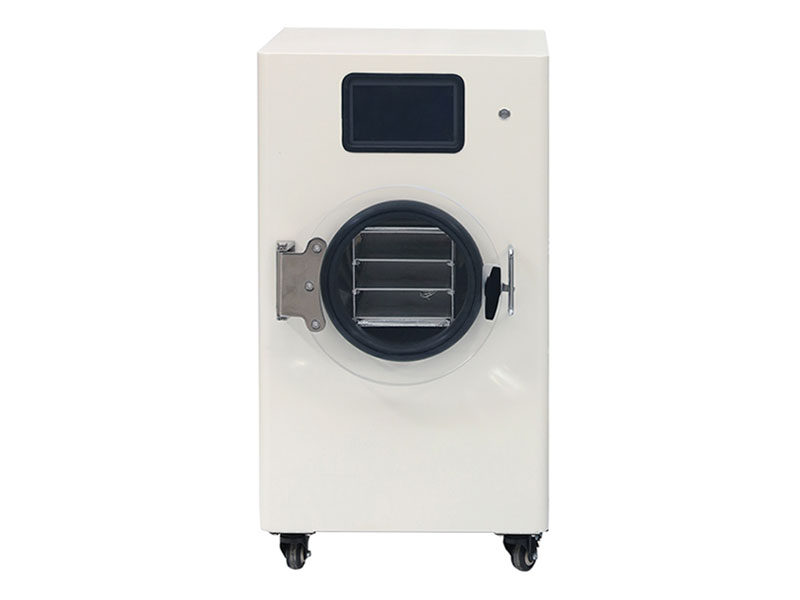
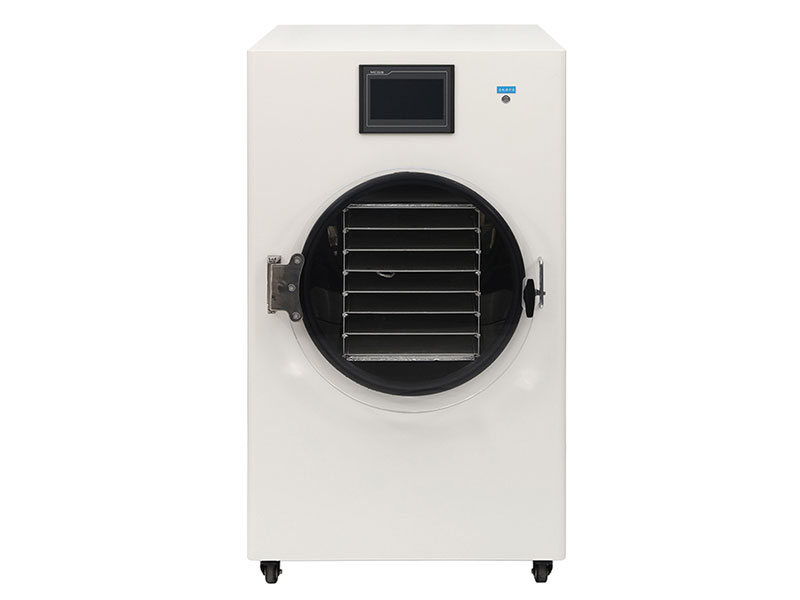
The food freeze dryer for sale in Guigong Machinery are mainly small freeze dryer designed for household use. A home freeze dryer is a small freeze-drying device developed for ordinary home environments, specifically for the low-temperature freeze-drying of home ingredients. Unlike large-scale freeze-drying production lines in factories, home freeze dryers are small, tabletop vacuum freeze-drying devices specifically designed for home use. This equipment is compact, low-noise, and intelligently operated, requiring no complex infrastructure. Utilizing vacuum sublimation for low-temperature dehydration, it retains the maximum amount of nutrients, color, and shape of the ingredients. The freeze-dried products do not require refrigeration and can be stored at room temperature for extended periods. Home freeze dryers produce freeze-dried food that looks almost identical to fresh food, with a porous and loose internal structure that allows it to quickly approach a fresh state after rehydration. The freeze-dried product has extremely low moisture content and, after being sealed to prevent oxygen deprivation, can be stored at room temperature for several years without occupying freezer space. It is a key piece of equipment for the industrial upgrading of snack foods, prepared meals, functional foods, baby food, and pet food.

| Model | HFD-1 | HFD-4 | HFD-6 | HFD-8 | HFD-15 |
| Freeze dried area | 0.1㎡ | 0.4㎡ | 0.6㎡ | 0.92㎡ | 1.45㎡ |
| Cold trap temperature | -50℃ | -50℃ | -50℃ | -50℃ | -60℃ |
| Processing capacity | 1–2 kg/batch | 4–6 kg/batch | 6–8 kg/batch | 10–12 kg/batch | 18–20 kg/batch |
| Ultimate vacuum | Below 2Pa | Below 2Pa | Below 2Pa | Below 2Pa | Below 2Pa |
| Material tray size | 145×275 mm | 200×425 mm | 315×430 mm | 265×430 mm | 265×780 mm |
| Number of trays | 3 | 4 | 4 | 8 | 7 |
| Tray spacing | 43 mm | 45 mm | 70 mm | 38 mm | 43 mm |
| Pumping speed | 2–4 L/s | 2–4 L/s | 2–4 L/s | 2–4 L/s | 2–4 L/s |
| Water harvesting ability | 3 kg/24h | 4 kg/24h | 6 kg/24h | 10 kg/24h | 18 kg/24h |
| Operating noise | ≤60 dB | ≤60 dB | ≤60 dB | ≤60 dB | ≤60 dB |
| Supply voltage (Customizable 110V or 380V) | 220V/50Hz | 220V/50Hz | 220V/50Hz | 220V/50Hz | 220V/50Hz |
| Machine dimensions | 450×500×825 mm | 500×640×900 mm | 680×640×1180 mm | 680×640×1180 mm | 680×990×1180 mm |
| Net weight | 73 kg | 84 kg | 125 kg | 130 kg | 186 kg |
| Package size | 570×680×117mm | 630×840×1260 mm | 820×800×1540 mm | 820×800×1540 mm | 820×1170×1600 mm |
| Gross weight | 113 kg | 139 kg | 197 kg | 203 kg | 281 kg |
| Whole machine power | 1100 W | 1500 W | 2000 W | 2500 W | 3500 W |
Leave more about your requirements, like models, quantities, countries, etc.
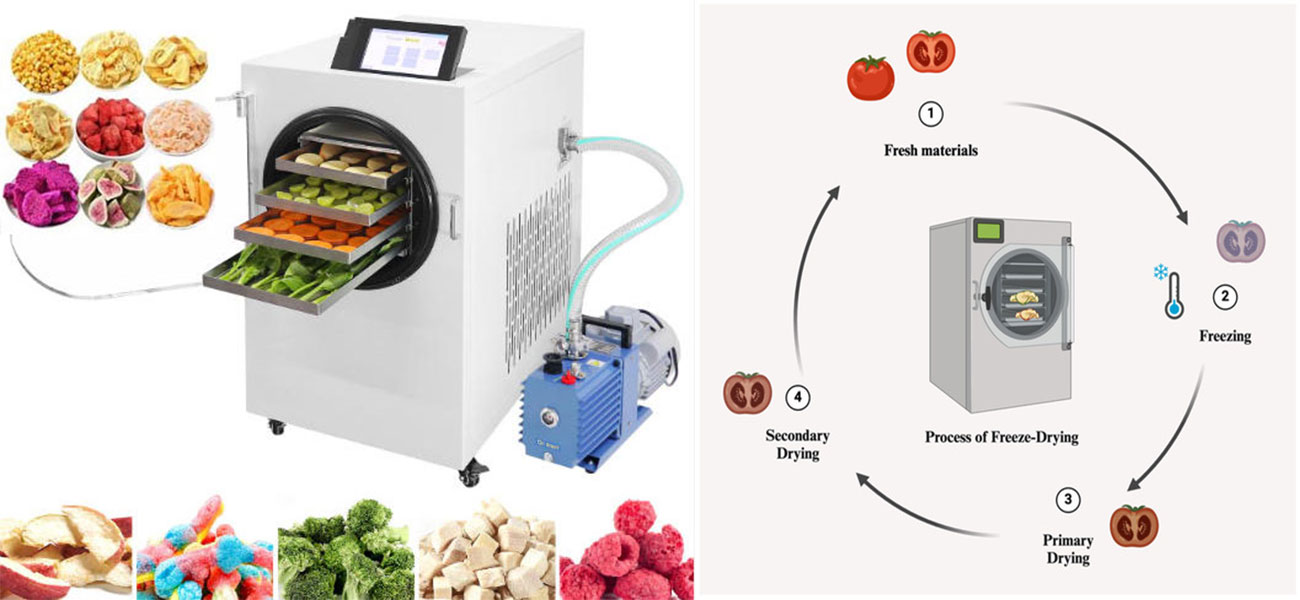
Solidifying moisture and locking in the original structure of the ingredients. The freeze dryer can rapidly lower the temperature of the freeze-drying chamber to -40℃ to -55℃ based on the eutectic point characteristics of different ingredients. Some high-sugar, high-moisture fruits and vegetables can be pre-frozen at even lower temperatures, continuously kept warm for 1-5 hours, allowing the free and bound water inside the ingredients to completely freeze into fine, uniform micro-ice crystals. This rapid freezing process prevents large ice crystals from piercing the cell walls of the ingredients, effectively preventing softening, collapse, nutrient leakage, and completely locking in the fiber structure, pulp shape, and flavor substances of the ingredients. This lays a uniform and stable dehydration foundation for subsequent sublimation drying, ensuring consistent shaping results for each batch of ingredients.
Removing most of the free moisture from the ingredients. After the pre-freezing and shaping of the ingredients, the equipment’s vacuum system is activated, stabilizing the pressure in the food-grade freeze-drying chamber to a high vacuum of 10-100Pa. Simultaneously, the heating system performs a micro-gradient temperature increase, providing stable heat energy for ice crystal sublimation. In a low-temperature vacuum environment, the solid ice crystals inside the food directly sublimate into water vapor. Without a liquid melting process, this completely avoids the food becoming soggy and losing flavor. This stage removes over 90% of the free water inside the food and is the core process of dehydration. The entire process is low-temperature and oxygen-free, perfectly preserving heat-sensitive nutrients such as vitamins, dietary fiber, amino acids, and flavor factors, and preventing oxidative browning.
Deep Removal of Bound Water, Extending Shelf Life After sublimation drying, a small amount of bound water remains inside the food, tightly bound to dietary fiber, pectin, and protein. At this time, the freeze dryer, under a high vacuum environment, precisely raises the chamber temperature to 25℃~50℃. Gentle heat breaks the binding force between water and food molecules, allowing the remaining bound water to fully decompose into water vapor and condense and be discharged. This stage lasts 3~6 hours, precisely controlling the food moisture content to the industry standard of 1%~5%, completely eliminating the problem of finished product rehydration and spoilage, and maximizing the extension of the freeze-dried food’s room temperature storage period.
Leave more about your requirements, like models, quantities, countries, etc.
The working logic of freeze dryer machine for home is to quickly freeze cleaned, chopped, and pre-treated ingredients at low temperatures, solidifying the internal free and bound water into uniform ice crystals. These are then placed in a high-vacuum, sealed, food-grade freeze-drying chamber. Through precise temperature control and heating, the ice crystals inside the ingredients sublimate directly into water vapor without melting in a liquid state and are then condensed and discharged. This achieves deep dehydration and drying without damaging the cell structure, nutrients, or flavor compounds of the ingredients. Food processed by a food freeze dryer can have its moisture content stably controlled at 1%~5%, fully preserving the original shape, color, taste, and nutrients. Furthermore, after sealing and packaging, it can be stored at room temperature for 1~3 years without cold chain preservation, greatly reducing food production, storage, transportation, and spoilage costs.
Leave more about your requirements, like models, quantities, countries, etc.
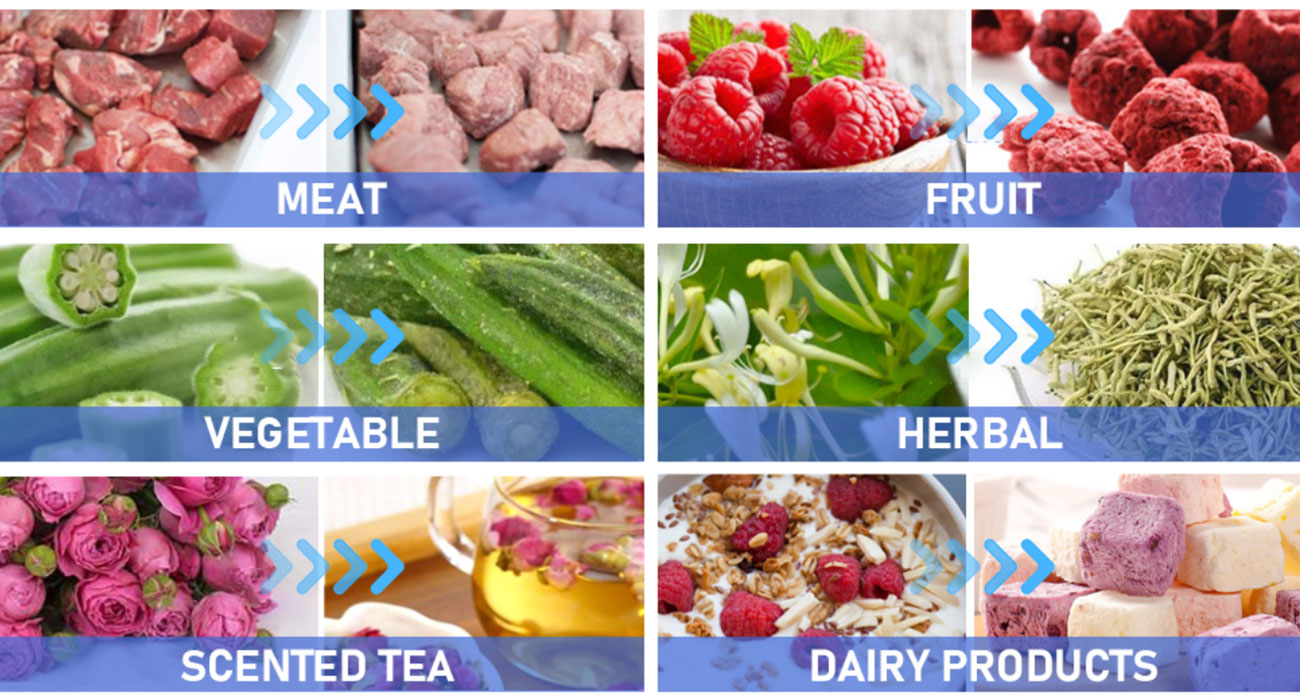
Slice and freeze-dry fresh fruits such as strawberries, mangoes, apples, mulberries, blueberries, and kiwis directly without adding sugar or preservatives, creating additive-free freeze-dried fruit snacks. Unlike commercially available sugar-coated dried fruits, these retain the original flavor of the fruit and are suitable as snacks for both children and adults. Various vegetables, such as broccoli, corn, carrots, and mushrooms, can be freeze-dried and used in quick soups or as camping side dishes. After rehydration, they taste almost like fresh vegetables.
This is the core purpose for many families purchasing home freeze dryers. Use ingredients such as chicken breast, duck, beef, salmon, and egg yolks to process freeze-dried snacks for cats and dogs at home. Control the source of the ingredients, avoid additives, and eliminate the risk of adulteration found in commercially available freeze-dried foods. These snacks can be stored for a long time and fed as needed. Note that freeze-drying high-fat meats is more difficult and requires adjustments to the processing parameters.
Fresh ingredients, after freeze-drying and sealing, can be stored for several years at room temperature away from light, using oxygen absorbers and aluminum foil bags, without the need for refrigeration. Suitable for storing grains, cooked meats, and soup blocks for family use, as well as for power outages and emergency supplies. Also suitable for outdoor camping and hiking, as freeze-dried ingredients are lightweight and easy to rehydrate, reducing the weight of backpacks.
Bone broth, fruit and vegetable juices, thick soups, and fruit purees can be processed into freeze-dried soup blocks and freeze-dried fruit puree blocks using a home freeze dryer. These can be quickly rehydrated by adding boiling water, creating homemade, additive-free instant meals suitable for busy professionals and the elderly.
Some home-based food makers and DIY entrepreneurs use home freeze dryers to sample new recipes and test the freeze-drying effects of ingredients.
Small quantities of precious ingredients, such as fresh ginseng, dendrobium, and fresh mushrooms, are dehydrated at low temperatures using a home freeze dryer to retain the maximum amount of active ingredients. They can then be stored at room temperature for a long time, avoiding mold and spoilage caused by refrigeration.
Leave more about your requirements, like models, quantities, countries, etc.
1). Match the processing capacity to your actual needs. Don’t just choose the largest. Larger capacities consume more power and occupy more space.
2). Chamber and tray materials. Prioritize 304 food-grade stainless steel, and choose food-grade silicone for the sealing rings, resistant to acidic fruits and vegetables.
3). Prioritize oil-free vacuum pumps to reduce the risk of food contamination by oil mist.
4). Cold trap minimum temperature. For home models, a cold trap temperature of ≤-55℃ is recommended to ensure the water-absorbing capacity of high-moisture foods.
5). Confirm power supply conditions. Most home models use a standard 220V socket. For larger models, confirm whether a dedicated circuit is required.
6). Pay attention to noise levels. For kitchen placement, choose a low-noise model.
Home food freeze dryers and large industrial freeze dryers share the same basic sublimation principle, but their hardware is completely different.
Refrigeration system. Large industrial freeze dryers use screw compressors and water cooling, offering strong heat load capacity and allowing for 24/7 continuous operation. Household freeze dryers, on the other hand, use small piston compressors with air cooling, suitable only for intermittent, small-batch home processing. Prolonged continuous operation will lead to reduced cooling capacity, decreased water trapping ability, and compressor overheating.
Production Capacity. Industrial machines start at several hundred kilograms per batch, while household machines range from several hundred grams to several kilograms.
Power Supply. Industrial machines require a factory, water cooling equipment, and a high-power power supply. Household machines can operate on standard 220V AC mains power.
Food freeze dryers for sale in our company are only suitable for home DIY and sample making. Forcing them into mass production will significantly shorten the equipment’s lifespan, result in unstable freeze-dried quality, and cause problems such as incomplete drying and moisture absorption.
External pre-freezing is not mandatory. In-situ integrated food freeze dryers allow fresh food to be placed directly into the chamber, where the pre-freezing process is completed internally. However, directly placing fresh ingredients into the freeze dryer requires significant time and electricity for cooling and freezing, noticeably lengthening the overall freeze-drying cycle. Some high-moisture ingredients may also freeze unevenly. If the ingredients are pre-frozen at -18℃ or below in a household freezer before being placed in the freeze dryer, the equipment can skip the pre-freezing stage and directly engage vacuum sublimation, shortening the overall processing time by 20-35%. This also reduces the continuous high-load operation time of the compressor, lowering power consumption and extending the machine’s lifespan.
1). High-fat pure oil ingredients. Pure fatty meat and butter do not undergo sublimation and dehydration. After freeze-drying, they remain in an oily state, making them unsuitable for dry preservation. Ingredients with a high fat content are also prone to oxidation and oil release in the freeze-dried product.
2). High-sugar viscous materials. Honey and high-concentration syrups form glassy crystals at low temperatures, making sublimation difficult. The material tends to collapse and stick to the drying tray, making drying challenging.
3). High-moisture, large, thick materials.
4). Large, thick pieces of meat. Excessive thickness obstructs the sublimation path of internal ice crystals, resulting in a dry outer layer but still containing moisture inside. Therefore, they must be sliced thinly.
5). High-alcohol-content ingredients. Alcohol vapor pressure is very high, and it will evaporate during the vacuum stage, potentially damaging the vacuum pump.
6). Dried goods with very low moisture content do not require freeze-drying.
The power consumption of a home freeze dryer is not fixed and is affected by multiple factors, including the moisture content of the ingredients, ambient temperature, whether the ingredients are pre-frozen externally, and the size of the machine.
A medium-sized mainstream home freeze dryer, if the ingredients are pre-frozen externally, will consume approximately 3-6 kWh for a complete 24-hour cycle.
If fresh ingredients are placed directly into the machine for pre-freezing, the compressor will operate at high load during the pre-freezing stage, increasing power consumption to 6-10 kWh.
Higher ambient temperatures result in higher power consumption, as the equipment experiences greater heat dissipation pressure, leading to a significant increase in power consumption.
The core of freeze dryers’ long-term food preservation lies in the dual technological guarantees of deep dehydration and sterile, oxygen-free processing.
First, freeze dryers reduce the moisture content of food to 1%-5% through three processes: pre-freezing, sublimation, and desorption. This almost completely removes free and residual bound water, inhibiting the growth of microorganisms, molds, and bacteria at the source, preventing spoilage.
Second, the entire processing is completed in a high-vacuum, sealed chamber with extremely low oxygen content, effectively preventing oxidation, browning, flavor loss, and component deterioration.
Finally, freeze-dried food has a stable internal structure. Sealed packaging isolates it from external moisture, dust, and bacteria, eliminating the need for cold chains and preservatives. It can be stably stored at room temperature for 1-3 years.