blacksmith power hammer

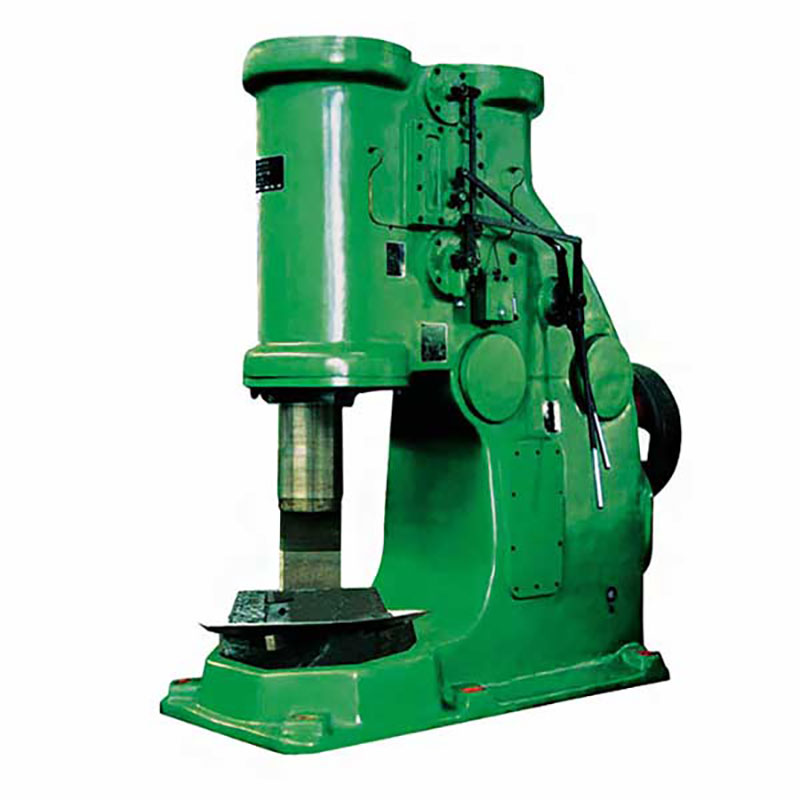
Blacksmith power hammer, also known as forging hammer machine, forging air hamme, is a motorized forging machine that uses compressed air to achieve automatic high-frequency forging. It is a core piece of equipment in modern blacksmithing and small-to-medium-sized metal forging. Blacksmith power hammers output stable, controllable, and high-frequency forging impact force through a pneumatic mechanical structure, enabling continuous precision shaping of high-temperature steel, alloys, and non-ferrous metals. Forging hammer machines are core equipment for small-to-medium-sized free forging, falling between manual forging and large hydraulic forging machines. Their core advantages lie in stability, efficiency, and controllability, combining flexibility and practicality. Whether it’s traditional wrought iron crafts, handmade knives, horseshoes, or industrial standard parts and mechanical structural components, basic forging processing can be completed using black smith power hammer.

Guigong Blacksmith forging hammer

Blacksmith Power Hammer for Sale in Guigong Machinery

C41-16KG Blacksmith Power Hammer

C41-16kg Blacksmith Forging Hammer

C41-20KG Blacksmith Power Hammer

C41-20kg Blacksmith Forging Hammer

C41-25KG Blacksmith Power Hammer

C41-25kg Blacksmith Forging Hammer

C41-40KG Blacksmith Power Hammer

C41-40kg Blacksmith Forging Hammer

C41-150KG Blacksmith Power Hammer

C41-55kg Blacksmith Forging Hammer

C41-150KG Blacksmith Power Hammer

C41-150kg Blacksmith Forging Hammer

C41-250KG Blacksmith Power Hammer

C41-250kg Blacksmith Forging Hammer

C41-400KG Blacksmith Power Hammer

C41-400kg Blacksmith Forging Hammer

C41-560KG Blacksmith Power Hammer

C41-560kg Blacksmith Forging Hammer

C41-750KG Blacksmith Power Hammer

C41-750kg Blacksmith Forging Hammer

C41-1000KG Blacksmith Power Hammer

C41-1000kg Blacksmith Forging Hammer

What are classifications of Blacksmith Power Hammer?

Classification by Hammer Head Nominal Weight

The nominal weight of the hammer head is the most crucial parameter of an air hammer, directly determining the maximum forging force, workpiece thickness, and continuous working load. It is also the core basis for industry model naming. Common weights available on the market are 6kg, 16kg, 25kg, 40kg, 65kg, 100kg, and 150kg. They can also be broadly categorized into four types based on weight range:

>> Miniature forging air hammers (6kg-16kg)

These have a small footprint, low energy consumption, and are easy to install. No special concrete foundation is required, they can be placed on a regular cement floor. They are primarily suitable for forging small craft items and can process thin steel, copper, aluminum, and other soft metals. They are also suitable for making knives, wrought iron ornaments, small hardware decorations, horseshoes, and other thin and light workpieces.

>> Small forging power hammers (25kg-40kg)

This is the best-selling and most versatile mainstream weight, standard equipment for small and medium-sized forging workshops. This type balances power and flexibility, processing most common metals such as ordinary carbon steel, low-alloy steel, stainless steel, and copper-aluminum alloys. It supports a full range of free forging processes, including stretching, upsetting, punching, bending, and torsion. It can meet both manual forging needs and is suitable for small-batch mass production of hardware parts and tool parts.

>> Medium-heavy-duty forging hammer machine (65kg-100kg)

Industrial-grade specialized equipment with high rigidity, large forging impact force, and high stability during continuous operation. The equipment requires a professional foundation for installation. Primarily used in machine shops, auto parts factories, and hardware mass production plants, it can process medium-thick metal billets and high-strength structural steel, suitable for forging industrial parts such as mechanical connecting rods, gear blanks, chassis parts, and agricultural machinery parts.

>> Large power forging hammer machine (150kg and above)

Heavy-duty forging specialized equipment, designed for large factories, which is large in size, high in energy consumption, and with stringent installation requirements. The large machine offers extremely strong forging power, capable of handling ultra-thick steel billets, high-strength alloy steel, and large structural components. They are mainly used in high-end forging scenarios such as heavy machinery, ship parts, aerospace auxiliary parts, and large mold blanks.

Classification by Forging Process

>> Free forging air hammer

The most mainstream general-purpose model on the market. It has no fixed, enclosed mold. Forging is completed manually by adjusting the workpiece angle and position. It offers flexible processing, easy modification, and no mold costs. It is suitable for small-batch, multi-category, and customized workpiece processing, as well as all conventional free forging processes.

>> Die forging air hammer

Used with a dedicated enclosed shaping mold. The mold limits the workpiece forging. Finished products are dimensionally precise, highly consistent, and produce no excess scrap. The type is suitable for standardized, high-volume parts production. However, the equipment has poor versatility. One set of molds can only produce one type of workpiece, and modifications require mold replacement. It is only suitable for standardized industrial production.

Classification by Machine Structure (Single-unit and Split-unit)

>> Single-unit forging hammer machine

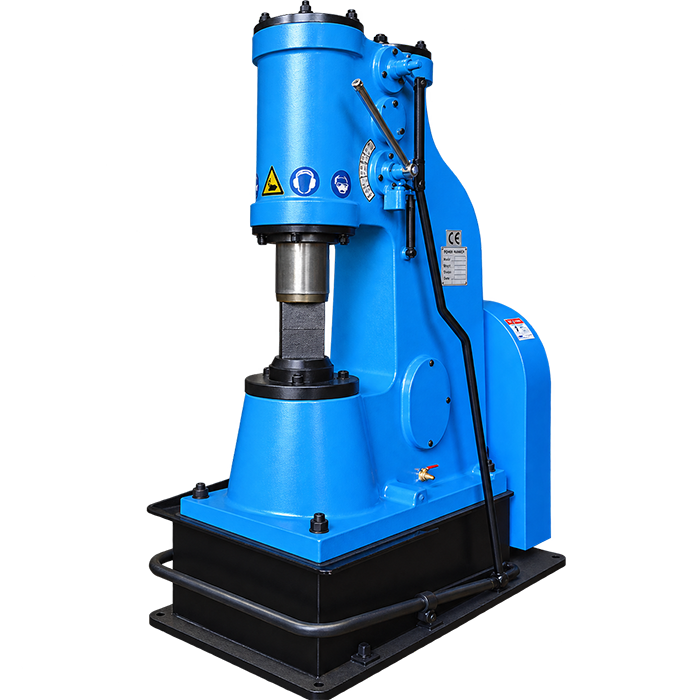
The overall structure is supported by a single column, providing an unobstructed operating view and more flexible manual workpiece adjustment. The hammer frame, cylinder assembly, and bottom anvil are integrated. The lower anvil is directly fixed to the machine’s base and can not be moved separately. Small air hammers generally use a single-unit structure. The entire forging machine is cast iron in one piece, with the compression cylinder, working cylinder, and support base integrated into a single frame. The impact force generated by hammering is transmitted within the machine body.

>> Split-type forging hammer machine

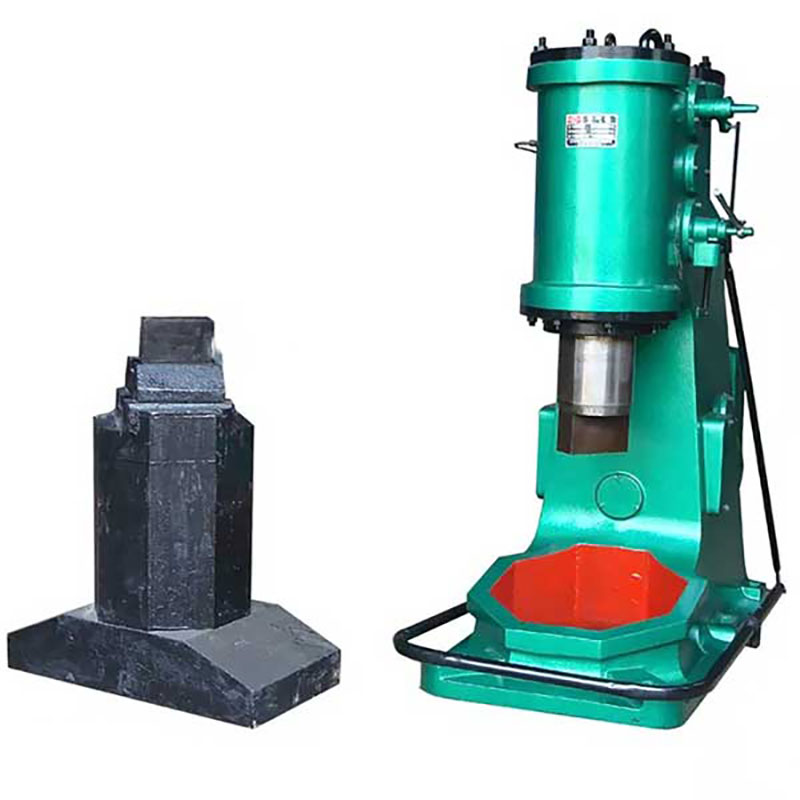
 The machine consists of two main parts, hammer body and power head, as well as an independent heavy-duty anvil, which are separate. They can be separated during transportation and hoisting. During installation, the power frame is placed above the independent large anvil. Medium and large-sized blacksmith power hammers such as 40kg, 65kg, 75kg, and 150kg widely use the split structure. The downward impact load of the hammer head is entirely absorbed by the independent heavy-duty anvil. The power body does not directly bear the impact load of the workpiece, and the impact vibration is isolated by the anvil and shock-absorbing wood.

Classification by Degree of Automation

>> Semi-automatic blacksmith power hammer

It is currently the common type in small and medium-sized forging workshops. The equipment completes the hammering power cycle, while manual workpiece positioning, flipping, feeding, and process adjustment are performed. The equipment controls the start and stop of the hammer head, the frequency of continuous strikes, and the intensity of strikes via a foot switch or control valve. The forging frequency and stroke can be mechanically adjusted in advance, and the machine automatically completes high-frequency reciprocating hammering. However, all workpiece angles, positions, and forming rhythms rely entirely on manual operation.

>> Fully automated blacksmith power hammer

The fully-automated type uses a CNC system as their core, with forging stroke, striking force, striking frequency, and cycle count all digitally preset. The CNC forging hammer machine automatically completes the entire hammering cycle without manual intervention in the striking rhythm. High-end models can be equipped with automatic feeding, robotic arm tilting, and automatic positioning mechanisms to achieve unmanned continuous forging. The equipment boasts high precision, extremely high product consistency, and excellent repeatability, making it perfectly suited for mass production of standardized parts.

Classification by Power

>> Pneumatic forging hammer

The motor drives the crankshaft connecting rod, which in turn drives the compression piston in reciprocating motion. The machine has a built-in compressed air cylinder that generates high-pressure air, which drives the working piston to move the hammer head to complete the forging process. It integrates an air compressor structure, eliminating the need for an external independent air compressor. It offers high flexibility in free forging and is a common model for blacksmith workshops and small to medium-sized processing plants. The vast majority of single-unit and split-unit air hammers belong to this type.

>> Hydraulic forging hammer

Relies on a hydraulic pump station to output high-pressure hydraulic oil to drive the hammer head. The power medium is hydraulic oil, eliminating the air compression stage. It boasts high striking energy, a high tonnage limit, and relatively smooth operating vibration. The striking energy is stable, making it suitable for heavy-duty die forging and high-strength forging of thick billets.

>> Purely mechanically driven forging hammer

An electric motor drives a cam and crankshaft to compress a spring, storing energy. The spring releases its force to drive the hammer head in striking, without relying on air pressure or hydraulic media. Currently, newly built forging workshops rarely purchase this type; only a few older workshops retain it.

Working principle of blacksmith power hammer
Would Like the Latest Price?

Leave more about your requirements, like models, quantities, countries, etc.

What Are Main Application Areas of Forging Air Hammer?

Forging air hammers are highly versatile forging equipment, covering five core areas: traditional forging processes, modern hardware mass production, mechanical parts processing, equipment repair and remanufacturing, and customized special-shaped parts processing. They can process most commonly used metal materials such as carbon steel, stainless steel, copper, aluminum, and low-alloy steel, supporting all basic free forging processes such as stretching, upsetting, punching, shearing, bending, twisting, forging, and finishing.

Traditional Forging Techniques

Widely used in the forging of handmade knives, swords, wrought iron ornaments, vintage farm tools, horseshoes, metal crafts, and garden wrought iron decorations. Air hammers offer uniform and controllable force, perfectly replicating traditional forging textures while avoiding the flaws of manual forging. They are standard equipment in modern intangible cultural heritage wrought iron and hand forging workshops.

Mass Production of Hardware Tools and Daily-Use Metal Products

Forging hammer machines are widely used for forging blanks of various hand tools and standard hardware parts, including wrenches, pliers, axes, hammers, screwdriver accessories, bolts, rivets, and hardware connectors. Through standardized forging processes, the internal grain structure of the metal is refined, increasing the density and strength of the workpiece, making the hardware tools more wear-resistant and impact-resistant. Compared to cast parts, forged hardware parts have better toughness, are less prone to breakage, and have a higher yield rate, making them suitable for stable small- to medium-batch mass production.

Machine Processing for Machinery, Auto Parts, and Agricultural Machinery Parts

Medium-sized blacksmith power hammers can be widely used in the machinery manufacturing, auto parts, and agricultural machinery parts industries to process core components such as engine connecting rods, gear blanks, chassis support parts, agricultural machinery rake teeth, shaft parts, and structural connectors. Forging processes can optimize the internal structure of metals, eliminate defects such as porosity and looseness, and significantly improve the mechanical strength, toughness, and service life of parts, making forged parts far superior in performance to ordinary cast parts.

Customized and Small-Batch Processing of Irregular-Shaped Parts

Forging air hammers can be widely used for customized processing of mechanical modification parts, equipment-specific parts, experimental samples, and niche industrial parts, making them the optimal equipment for non-standard forging scenarios. For non-standard irregular-shaped metal parts, customized parts, and experimental workpieces, the free forging advantages of air hammer machine are fully demonstrated. Because it requires no mold opening or customized tooling, various complex shapes can be formed simply by manually adjusting the workpiece’s posture, greatly reducing customized production costs and shortening the production cycle.

Industrial Equipment Repair and Remanufacturing Industry

In the fields of mining, engineering, and agricultural machinery repair, blacksmith power forging hammers are commonly used for straightening deformed metal parts, repairing worn parts, forging broken parts, and forging replacement blanks. Replacing many large mechanical parts entirely is extremely costly. By using forging air hammers for localized forging, straightening, repair, and shaping, parts can be repaired and reused, significantly reducing equipment maintenance costs and improving repair efficiency.

Would Like the Latest Price?

Leave more about your requirements, like models, quantities, countries, etc.

FAQs of Blacksmith Power Hammer

1. Are blacksmith power hammer and handheld hammers the same?

They are completely different devices. A blacksmith power hammer is a stationary heavy-duty forging machine that relies on an air compressor to provide a high-pressure air source. It can continuously and frequently forge metal blanks for metal shaping and forming. A handheld hammer is a portable small tool that can only perform light operations such as rust removal, chiseling, crushing, and trimming. It has very little force and no forging capability, and cannot be used for blacksmithing forging production.

2. What’s the Working Principle of Blacksmith Power Hammer?

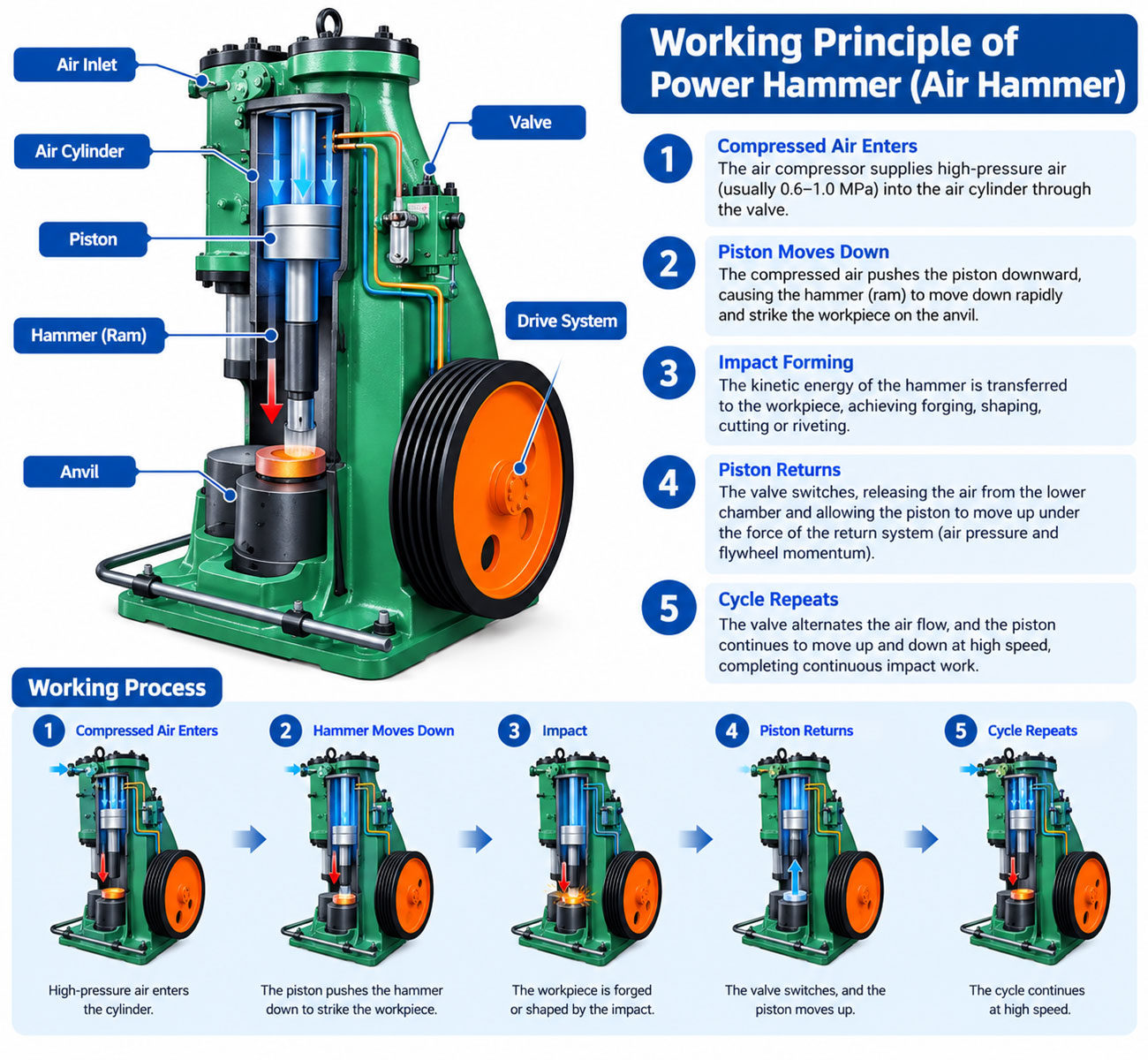
Blacksmith power hammers are piston-type pneumatic forging equipment that relies on compressed air within a cylinder to drive the hammer body in reciprocating high-speed impacts, achieving metal forging and shaping. The core power source of an forging air hammer is compressed air. The entire system achieves continuous, high-frequency automatic forging through multi-stage energy conversion from electrical energy to mechanical energy to pneumatic energy to impact mechanical energy. Most commercially available integrated forging air hammers have built-in air compression mechanisms, eliminating the need for an external air compressor. Large CNC automatic blacksmith hammers do not have built-in compression cylinders and require a continuous supply of high-pressure gas from an external air compressor to drive the hammer head.

3. Is it necessary to use a dedicated air compressor when using a forging air hammer?

Forging air hammers require a stable industrial air compressor for continuous operation. Ordinary small, low-pressure air compressors cannot meet the demands. Different models have different air pressure and displacement standards. Small air hammers (6-40kg) require a stable air pressure of 0.6-0.8MPa. Heavy-duty models (65kg and above) require a large-displacement, high-pressure air compressor. Insufficient air pressure or flow will result in weak forging, unstable frequency, and poor workpiece forming, severely impacting production efficiency.

4. Can Blacksmith power hammers forge stainless steel and high-hardness alloy steel?

Yes. However, only standard blacksmith power hammers (25kg and above) have this capability. Miniature 6-16kg models can’t process high-hardness materials. Before forging stainless steel and alloy steel, the workpiece must be heated to the standard forging temperature for uniform softening to reduce the metal’s hardness and brittleness, preventing cracking and chipping during forging. This also prevents overloading of the hammer head and equipment damage. During processing, the striking frequency should be reduced, and the force of each strike increased.

5. What forging processes can forging power hammer perform?

A standard forging power hammer can complete all conventional free forging processes, covering metal stretching, upsetting and thickening, billet punching, workpiece shearing, metal forging, angle bending, texture twisting, and surface finishing. It basically covers all the needs of manual forging and small-to-medium-sized industrial forging.

6. Is the blacksmith power hammer for sale in your company suitable for forging and easy to operate?

Yes, especially the 16kg and 25kg models, which have an extremely low operating threshold. The equipment uses foot pedal control, freeing up your hands for easy workpiece adjustment. The striking force and frequency are flexibly adjustable, making operation simple, easy to understand, and quick to learn. At the same time, mechanical forging provides uniform and stable striking force, avoiding the large deviations found in manual forging.

7. How to precisely adjust the striking force and frequency of forging air hammer?

The striking force is controlled by adjusting the air compressor output pressure and the hammer stroke. Higher air pressure and a longer stroke result in a greater impact force per forging stroke, which is suitable for rough forging of thick and hard materials. The striking frequency is adjusted via a built-in regulating valve and motor speed. High-frequency, light strikes are suitable for fine shaping and texture finishing of workpieces. Operators can freely switch parameters according to workpiece thickness, material hardness, and processing steps to achieve precise matching of rough and fine processes.

8. What is the normal service life of the forging power hammer for sale in your company?

Under proper operation and regular maintenance, the normal service life of the forging power hammer for sale in our company can reach 8-15 years. The core components of the equipment, such as the hammer head, cylinder, and guide rail, are all made of high-strength wear-resistant alloy material, which is impact-resistant, high-temperature resistant, and not easily damaged. Regular lubrication, pipeline cleaning, and tightening and maintenance can significantly reduce the rate of wear and aging. Long-term overload operation, dry grinding without lubrication, and operation with malfunctions will significantly shorten the equipment’s lifespan.

9. Is the forging air hammer noisy and vibrating?

Forging air hammers produce normal mechanical vibration and forging noise during operation. The equipment is equipped with a thickened cast iron base and a buffer structure, which can absorb most of the vibration, preventing ground resonance and machine shaking. Some models are equipped with a noise-reducing cover, which can effectively reduce operating noise. With fixed foundation installation and vibration damping pads, the working environment can be further optimized, making it fully suitable for daily operations in ordinary workshops and factories.

10. Can ordinary free forging air hammers be used for die forging and mass standardized production?

Ordinary free forging air hammers are not suitable for high-precision closed die forging. They can only complete simple shaping processing and cannot meet the stringent requirements of standardized mass production. Dedicated die forging air hammers, paired with customized closed dies, can achieve mass production of fixed-shape parts, resulting in uniform finished product dimensions, neat edges and corners, and a high yield rate. For large-scale, high-precision standardized mass production, it is recommended to choose a professional die forging model. Ordinary models are more suitable for customized, small-batch free forging.

11. What thickness of metal workpiece can different models of forging power hammers process?

6-16kg micro models are suitable for 5-20mm thin materials and are only used for processing small process parts. 25-40kg small models can process 10-50mm conventional blanks and are suitable for most hardware and process workpieces. Medium-sized air hammers (65-100kg) can process medium-thick steel billets (30-100mm) for industrial parts forging. Heavy-duty models (150kg and above) can process materials thicker than 100mm, suitable for heavy industrial forging scenarios.

12. How to choose a suitable blacksmith power hammer?

It requires comprehensive consideration of the usage scenario, workpiece specifications, production capacity requirements, factory space, and budget. For personal craft projects, choose a micro-model. For small workshops and general processing, choose a 25-40kg model. For factory mass production, choose a large-to-medium-sized industrial model. Prioritize cast iron bodies, good sealing performance, and strong structural rigidity from reputable manufacturers, and ensure a compatible air compressor. Avoid blindly purchasing large-tonnage equipment that may become idle, and avoid overloading small models.

Feel free to inquiry us here!

    Scroll to top
    X