Leave more about your requirements, like models, quantities, countries, etc.
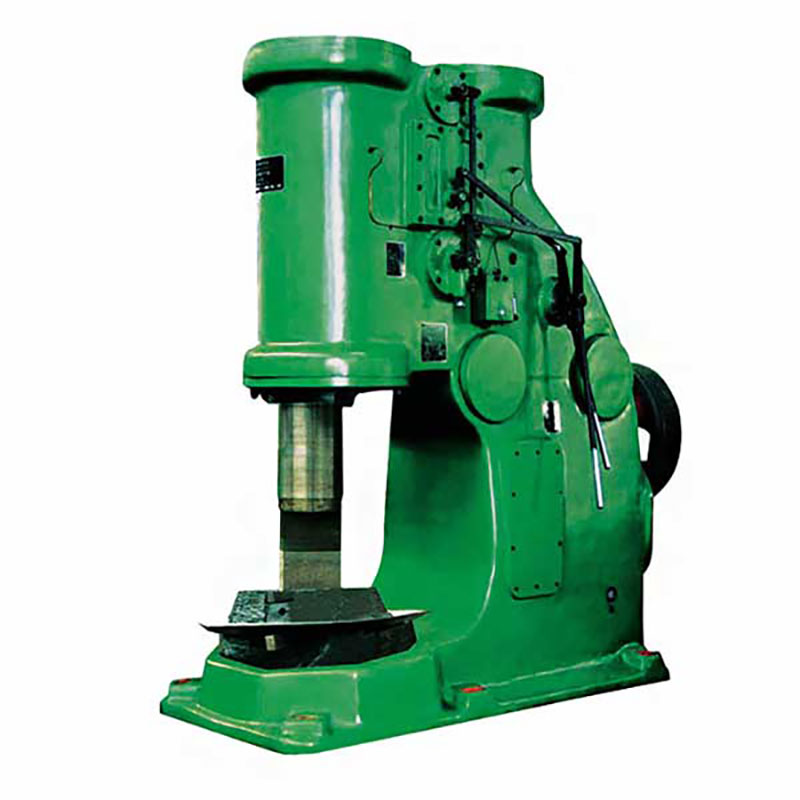
Pneumatic forging hammer is a core pneumatic free forging device in the forging industry. It uses compressed air as its sole power source, driving a hammer head to reciprocate at high frequency to impact metal billets, achieving plastic deformation processing. This equipment eliminates the boiler system of traditional steam hammers and the complex hydraulic circuit structure of hydraulic forging hammers. With its simple structure, low energy consumption, flexible operation, and strong adaptability, it is widely used in hardware forging, mechanical parts processing, agricultural implement and tool production, aw well as heavy-duty blank shaping.
The striking force of the pneumatic air hammer can be precisely adjusted, with a stable striking frequency of 200-300 times/minute. It is suitable for hot forging of various metals such as carbon steel, stainless steel, alloy steel, copper, and aluminum. The equipment can meet the needs of small-batch manual forging as well as standardized assembly line forging operations, making it a core piece of equipment for small and medium-sized forging enterprises.
The frame serves as the overall load-bearing and support foundation for the equipment. It is made of integral cast steel and includes the hammer body, working cylinder head, compression cylinder head, and base, providing high rigidity, vibration resistance, and resistance to deformation. All transmission, working, and control mechanisms are fixed to the frame, ensuring the overall stability of the equipment during forging operations and preventing machine displacement and shaking caused by high-frequency impacts.
Primarily composed of a motor, reducer, crankshaft, connecting rod, and transmission gears, this is the power source of the equipment. The motor outputs rotational power, which is reduced and amplified by the reducer, then drives the compression piston to reciprocate through the crankshaft and connecting rod, completing the air compression operation and providing stable pneumatic power support for the hammering action.
Comprising a dual-cylinder structure of a compression cylinder and a working cylinder, this is the core chamber for air pressure conversion. The compression cylinder pressurizes atmospheric air and stores high-pressure air; the working cylinder receives the high-pressure airflow and drives the piston and hammer head. The two cylinders work together to ensure continuous air pressure output, making it the core carrier for the equipment’s hammering function.
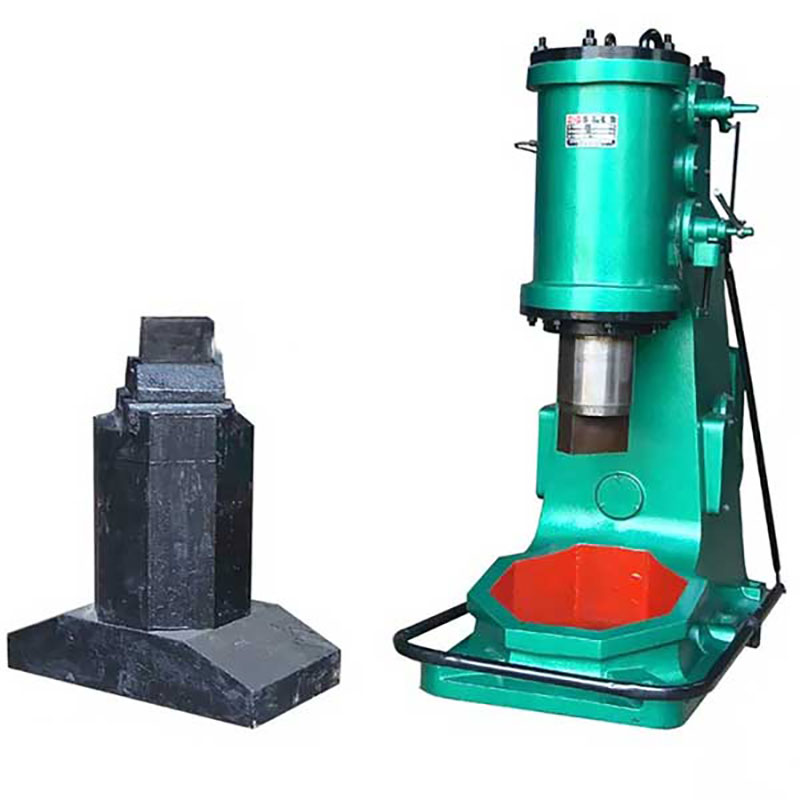
Consists of the hammer rod, hammer head, upper anvil, lower anvil, anvil pad, and anvil seat, directly completing the metal forging process. The anvil seat has a mass 12-15 times the mass of the falling part of the equipment, providing significant weight and stability, effectively buffering forging impact vibrations. The upper and lower anvils are wear parts and can be replaced according to workpiece specifications to adapt to different forging needs.
The core components are the rotary valve, valve core, and operating handle assembly, serving as the equipment’s “control center.” By manually operating the handle, the air passage of the rotary valve is switched, enabling four working conditions: hammer lifting, continuous striking, downward pressing, and idle operation. Simultaneously, the air intake can be precisely adjusted to control the hammer’s striking force and stroke, adapting to the forging process requirements of different workpieces.
Includes a cylinder buffer pad, shock-absorbing base, and limiting device. Its main function is to buffer the impact force of the hammer’s reciprocating motion, preventing metal-to-metal contact and resulting equipment wear. It also reduces overall machine vibration and noise, protects core components such as the cylinder and hammer rod, extends equipment life, and improves operational safety.
Composed of an air intake pipe, air pressure regulating valve, filter, and pressure relief valve, it is responsible for filtering moisture and impurities from the compressed air, stabilizing the air intake pressure, and preventing air pressure fluctuations from affecting forging accuracy. It also has an overload pressure relief protection function to prevent equipment failure caused by excessive cylinder pressure.
Leave more about your requirements, like models, quantities, countries, etc.
Steam forging hammers require boilers, water and steam pipelines, and water treatment equipment, resulting in high infrastructure costs, high energy consumption, and severe pollution, as well as long preheating times. In contrast, pneumatic air hammers only require a regular air compressor, eliminating the need for a boiler system. They can operate immediately upon startup, with no waste gas or residue emissions, reducing energy consumption by over 40%, significantly lowering maintenance costs, and avoiding boiler safety hazards, making them suitable for the production needs of small and medium-sized enterprises.
Hydraulic forging hammers rely on complex hydraulic circuits, pumps, cylinders, and solenoid valve systems. The components are precision-engineered and expensive, making them prone to leaks, valve blockages, and unstable pressure, resulting in difficult and costly maintenance. Pneumatic air hammers, on the other hand, rely on pure air pressure transmission, eliminating the need for an oil circuit system. Their simple structure and durable components result in a failure rate less than 1/5 that of hydraulic hammers. Routine maintenance requires only simple lubrication and dust removal, and they offer extremely high long-term stability.
Electric forging hammers rely on direct motor drive, resulting in rigid power output and unadjustable impact. This can easily lead to workpiece breakage and equipment overload burnout, and they are unsuitable for forging high-strength alloy steel. Pneumatic air hammers offer flexible and controllable air pressure power, allowing precise adjustment of striking force and frequency. They provide good cushioning, resulting in uniform workpiece forming without cracking. They are adaptable to various metals of varying hardness and can operate in harsh environments such as explosion-proof, dusty, and humid conditions.
Leave more about your requirements, like models, quantities, countries, etc.
The core working principle of a pneumatic air hammer machine is the conversion of compressed air power into cyclical air impact. The entire operation is automated and cyclical, requiring no manual assistance. It consists of five main steps, air intake, compression, air distribution, hammering, and resetting. Continuous operation is achieved through precise airflow control via the air distribution mechanism.
First, an external air compressor produces standard compressed air at 0.6-0.8 MPa, which enters the equipment’s compression cylinder through the intake pipe, driving the compression piston in a reciprocating motion, completing secondary air pressurization and storage.
Then, the air distribution mechanism switches airflow channels according to operating commands, precisely guiding the high-pressure air into the upper and lower chambers of the working cylinder. When the high-pressure air enters the upper chamber of the working cylinder, it pushes the working piston, hammer rod, and hammer head downwards rapidly, applying strong impact to the high-temperature metal billet placed on the anvil, completing forging and shaping. When the airflow switches to the lower chamber of the working cylinder, the air pressure pushes the hammer head upwards rapidly to reset.
Simultaneously, the air distribution mechanism can switch between four core working modes, hammer lifting, continuous striking, downward pressing, and idle standby. Operators can switch working conditions and precisely control the striking force, frequency, and stroke using a simple handle. The entire power cycle requires no fuel, steam, or hydraulic oil. It is purely pneumatically driven, ensuring stable power output and uniform impact force, effectively avoiding problems such as uneven deformation and cracking of metal billets during forging.
Leave more about your requirements, like models, quantities, countries, etc.
Flexible operation. Four working modes can be switched with one button, allowing beginners to quickly get started, and low labor costs.
High operating efficiency, high-frequency continuous striking, suitable for mass production.
Controllable precision, uniform forging dimensions, high density, and high product yield.
Low infrastructure requirements. No special foundation or complex supporting facilities are needed; production can begin immediately upon installation.
Long service life. The cast steel body is wear-resistant and durable, and can be used for more than 10 years with normal maintenance.
The standard working air pressure for a pneumatic air hammer is 0.6-0.8MPa, which is the optimal pressure range designed for the equipment. If the air pressure is below 0.6MPa during operation, it will result in insufficient cylinder power, weak hammer striking force, insufficient stroke, incomplete forging and shaping of metal billets, uneven deformation, springback, and loose forming, significantly reducing the precision and density of forgings. If the air pressure exceeds 0.8MPa, it will cause overload and pressure on the cylinder and valve core, accelerating wear on components and easily leading to malfunctions such as air passage leakage, valve jamming, and severe machine vibration. In severe cases, it can even cause the cylinder to crack. Therefore, a pressure stabilizing filter must be used during operation to stabilize the air pressure in real time, ensuring stable equipment operation and forging quality.
Pneumatic air hammer is a commonly used piece of equipment for processing these high-strength metal blanks. The high-frequency, gentle impact of blacksmith air hammer can gradually complete the plastic deformation of hard metals, avoiding stress concentration and cracking. However, forging hard metals requires a model with the appropriate tonnage. Small 25kg and 40kg models are suitable for forging thin materials and small parts of hard metals, while thick materials and large parts require medium to large models of 65kg or above. Simultaneously, strict control of the heating temperature is necessary to ensure the metal reaches a plastic state, avoiding equipment wear and workpiece scrap caused by cold forging and hard forging.
The core differences between split-type and integrated-type pneumatic air hammers lie in their body structure, stability, precision, and price. Selection should be based on processing precision and budget.
Split-type models have separate bodies and anvils, resulting in a simpler structure, lower price, easier maintenance, and stronger parts versatility. They offer moderate vibration damping and are suitable for forging ordinary blanks, processing hardware tools, and conventional mechanical parts, offering high cost-effectiveness. It is the first choice for small and medium-sized processing plants.
Integrated-type models are integrally cast steel, resulting in stronger body rigidity, minimal vibration, higher forging precision, more stable operation, and a lower failure rate. However, they are more expensive, heavier, and more inconvenient to transport and install. They are suitable for mass production of precision hardware, high-precision mechanical parts, and small-tolerance forgings. They are the preferred choice for scenarios with high processing quality requirements.

Pneumatic air hammers have extremely low installation requirements, eliminating the need for the high-strength, heavy foundations required for hydraulic hammers and presses, making them very easy to set up and put into production. Small models (16-40kg) only require a flat cement surface for installation and fixation, without the need for a pre-buried foundation. Medium models (65-100kg) only require a 10-20cm thick, flat concrete surface and proper leveling. Large models (150kg and above) only require a simple reinforced foundation. The equipment has a built-in vibration damping structure. When used with vibration damping pads, it can significantly reduce operational vibrations, without affecting the factory structure or surrounding equipment.
Pneumatic air hammers can perform simple open die forging, but they are not suitable for high-precision closed die forging. They are the preferred low-cost die forging equipment for small and medium-sized factories. The equipment can be equipped with customized die pads and simple forming molds to complete the die forging of various irregular-shaped forgings, replacing expensive dedicated die forging equipment and significantly reducing production costs. Compatible processes include small irregular-shaped hardware, irregular-shaped fasteners, simple mechanical parts, and tool shaping die forging. The die forging accuracy meets the production standards for civilian and general-purpose mechanical parts. However, die forging operations require matching the corresponding tonnage model to avoid forging large molds with small equipment. Simultaneously, it is necessary to ensure the mold is securely installed to prevent operational deviation, which could affect forming accuracy and operational safety.
If used correctly and with regular maintenance, pneumatic forging hammers for sale in our company can last 10-15 years. The core cast steel body is almost durable for its entire lifespan, requiring only periodic replacement of easily worn parts.
Firstly, daily maintenance. Long-term lack of lubrication, dust accumulation, and operation with excessive air pressure will accelerate the wear of the cylinder, piston, and transmission components.
Secondly, the degree of operational compliance. Empty hammer striking, uneven forging, and cold forging can cause machine vibration damage and anvil surface cracking.
Thirdly, the quality of components matters. Long-term use of inferior seals and anvils will accelerate equipment wear and tear.
Proper maintenance, standard operation, and the use of original parts can maximize the lifespan of the equipment.
Upgraded pneumatic air hammers are fully compatible with automated production lines, making them the preferred equipment for intelligent upgrades in forging workshops. Modified semi-automatic pneumatic air hammers can be adapted for mass production of hardware and mechanical parts, balancing flexibility and efficiency. Compared to fully automatic dedicated forging equipment, they have lower modification costs, wider adaptability, and extremely high cost-effectiveness, making them suitable for intelligent upgrades in small and medium-sized enterprises.
Common upgrades include:
Adding a frequency converter and voltage regulator system and an automatic pressure control module to achieve precise and controllable forging parameters.
Equipping semi-automatic feeding and positioning fixtures to reduce manual intervention.
Add counting, limit, and overload protection systems to achieve standardized batch operations.