
Would Like the Latest Price?
Leave more about your requirements, like models, quantities, countries, etc.
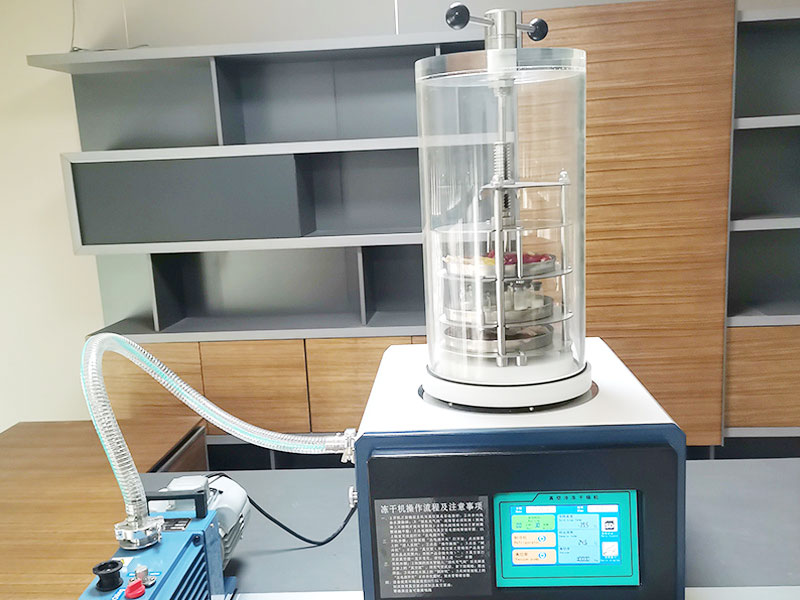
| Model | ZLGJ-10 Top-press Type | ZLGJ-12 Top-press Type | ZLGJ-18 Top-press Type |
| Specification | Lab Freeze Dryer | ||
| Freeze-drying Area | 0.08m² | 0.08m² | 0.09㎡ |
| Cold Trap Coil Temperature | -55℃ (no load), optional -80℃ (no load) | ||
| Ultimate Vacuum | ≤5Pa (no load) | ||
| Pumping Speed | 2L/S | 2L/S | 4L/S |
| Water Capturing Capacity | 3~4kg/24h | 3~4kg/24h | 6kg/24h |
| Cooling Method | Air cooling | ||
| Defrosting Mode | Natural defrosting | ||
| Main Unit Weight | 48kg | 63kg | 88kg |
| Main Unit Dimension | 520×600×400 (mm) | 600×480×770 (mm) | 560×560×980 (mm) |
| Total Power | 950W | 950W | 1100W |
| Sample Tray | 3 pcs sample trays, diameter Φ180mm, max spacing between press cover shelves 70mm | 3 pcs sample trays, diameter Φ180mm, max spacing between press cover shelves 100mm | 3 pcs sample trays, diameter Φ200mm, max spacing between press cover shelves 70mm |
| Round-bottom Flask | — | ||
| Vial Holder | Vials Φ12mm: 516 pcs Vials Φ16mm: 288 pcs Vials Φ22mm: 150 pcs | Vials Φ12mm: 516 pcs Vials Φ16mm: 288 pcs Vials Φ22mm: 150 pcs | Vials Φ12mm: 639 pcs Vials Φ16mm: 360 pcs Vials Φ22mm: 189 pcs |
| Operating Ambient Temperature | 10℃~30℃ | ||
| Relative Humidity | ≤70% | ||
| Power Supply | Single phase 220V±10%, 50Hz | ||
| Working Environment | Free of conductive dust, explosive/corrosive gas and strong electromagnetic interference | ||
| Transportation & Storage Temperature | −40℃ to 50℃ | ||
Leave more about your requirements, like models, quantities, countries, etc.
Top-Press Freeze Dryer is a laboratory freeze dryer equipped with a manual or hydraulic top-press mechanism that seals partially stoppered glass vials inside the vacuum chamber immediately after the drying process. This design is commonly referred to as a stoppering freeze dryer because the rubber stopper is inserted while the chamber is still under vacuum. Its key feature is the ability to perform freeze-drying and sealing in a single, integrated operation within a vacuum drying chamber, completely eliminating issues such as moisture absorption, oxidation, and contamination caused by material exposure to air.
Unlike ordinary tray-type freeze dryers, this system is specifically engineered for pharmaceutical containers such as serum vials, antibiotic bottles, vaccine vials, and injectable formulation containers.
Traditional freeze-dryers require the chamber to be opened after drying for manual or mechanical sealing, exposing materials directly to ambient air. This makes them highly susceptible to absorbing moisture, dust, and bacteria, while active materials risk oxidation and loss of potency. In contrast, the stoppering freeze-dryer performs both freeze-drying and stoppering synchronously within the vacuum chamber. The process remains completely sealed with no air contact, perfectly solving issues related to moisture absorption, oxidation, and contamination—making it particularly suitable for processing highly active and high-purity materials.
The equipment operates entirely under low-temperature vacuum conditions, keeping the drying temperature consistently below the material’s heat-sensitivity threshold. This ensures that heat-sensitive components—such as biological proteins, peptides, enzymes, and vitamins—remain intact. The dried material retains a porous, sponge-like structure with no change in volume or shape. It exhibits excellent rehydration properties, rapidly returning to its original state and activity upon the addition of water—far outperforming traditional drying methods such as oven drying or air drying.
Equipped with an intelligent touch-control operating system, the stoppering freeze-dryer allows for the pre-programming of the entire process—including freeze-drying, temperature control, vacuum cycles, and vial stoppering. It supports fully automated, one-touch operation, eliminating the need for constant manual monitoring. Features such as automatic data storage, adjustable parameters, self-diagnostic functions, and USB data export minimize human error while accurately recording experimental and production data, thereby meeting requirements for scientific traceability and standardized production.
Materials processed and vacuum-sealed in the stoppering freeze-dryer achieve extremely low moisture content and superior sealing integrity. By effectively blocking oxygen, moisture, and microbial contamination, the shelf life of the product can be extended by three to five times compared to conventionally dried products.
Leave more about your requirements, like models, quantities, countries, etc.
This is the primary application sector, utilized for the freeze-drying of products such as powdered injections in vials, vaccines, antibodies, probiotics, biological strains, and medicinal peptides. Following vacuum freeze-drying and in-situ stoppering, the products maintain stable efficacy and biological activity with significantly extended shelf lives, fully complying with stringent pharmaceutical standards for sterility and precision.
Widely used for sample pretreatment in laboratories across fields such as life sciences, chemical materials, environmental testing, and food science. Applications include the drying of nanomaterials, preparation of polymer materials, freeze-drying of soil and sludge samples, extraction of active ingredients from traditional Chinese medicines, and preservation of biological samples. Compact stoppering freeze-dryers offer precise parameter control, providing stable and traceable data for research experiments, as well as facilitating small-scale R&D for new product formulations.
Used in the processing of premium nutritional tonics, functional foods, fruit and vegetable extracts, and probiotic supplements—such as freeze-dried bird’s nest, freeze-dried Cordyceps, fruit and vegetable powders, and active probiotic powders. The equipment preserves the nutritional content, color, and texture of food products intact—ensuring no additives are used and no nutrients are lost—while vacuum sealing guarantees the quality and storage stability of premium food items.
Suitable for the drying of fine chemical products such as ultrafine powders, catalysts, nanomaterials, and polymer reagents. It effectively prevents issues like agglomeration, oxidation, and degradation during the drying process, ensuring uniform particle size and meeting purity standards, thereby enhancing the performance and quality of new material products.
Leave more about your requirements, like models, quantities, countries, etc.
The primary difference is the stoppering function. A standard freeze dryer dries samples successfully but requires operators to remove open vials after venting the chamber. A Top-Press Freeze Dryer presses rubber stoppers into the vials while vacuum is maintained, preventing moisture absorption and contamination. Laboratories developing pharmaceutical formulations generally prefer the top-press model because it better simulates commercial lyophilization processes.
Vacuum stoppering protects freeze-dried products from atmospheric humidity immediately after drying. Many pharmaceutical and biological materials are highly hygroscopic, meaning they rapidly absorb moisture from air. Sealing the vial under vacuum preserves residual moisture levels, reduces oxidation, improves shelf life, and ensures more reliable stability testing throughout product development and analytical evaluation.
Top-Press Freeze Dryers are widely used in pharmaceutical companies, biotechnology laboratories, vaccine research centers, universities, hospitals, diagnostic reagent manufacturers, and contract research organizations. They are especially suitable for laboratories developing injectable formulations, monoclonal antibodies, peptides, probiotics, enzymes, and molecular diagnostic products that require sterile vial packaging and controlled moisture protection.
Yes. Most benchtop top-press freeze dryers support both bulk tray drying and pharmaceutical vial drying. Researchers can place powders, extracts, or food samples on trays, while pharmaceutical formulations are processed inside partially stoppered glass vials. This dual-purpose capability makes the equipment highly versatile for multidisciplinary research laboratories handling different sample types.
Top-Press Freeze Dryers typically accommodate standard pharmaceutical serum vials ranging from 2 ml to 50 ml. Common sizes include 2 ml, 5 ml, 10 ml, 20 ml, and 50 ml injection bottles. Adjustable shelf spacing enables laboratories to process different vial heights without replacing the equipment, making it suitable for a wide range of pharmaceutical container formats.
During loading, rubber stoppers are placed loosely on each vial rather than fully inserted. After primary and secondary drying are completed, the top pressing plate descends uniformly and pushes every stopper firmly into the vial while vacuum remains inside the chamber. Only after all vials are sealed is atmospheric pressure gradually restored, preserving product integrity and preventing moisture uptake.
Yes. Vaccine formulations often require freeze drying to improve storage stability and transportation convenience. Vacuum stoppering minimizes exposure to oxygen and humidity, helping preserve antigen activity and formulation quality. As a result, top-press laboratory freeze dryers are commonly used during vaccine formulation screening, process optimization, and preclinical pharmaceutical research before pilot-scale manufacturing begins.
Yes. Manual top pressing provides reliable stoppering performance for small and medium research batches while maintaining relatively low equipment cost. Universities and academic laboratories often choose manual systems because they are easy to operate and require minimal maintenance. For larger pharmaceutical R&D programs requiring maximum consistency, hydraulic stoppering may offer additional advantages.