
Would Like the Latest Price?
Leave more about your requirements, like models, quantities, countries, etc.
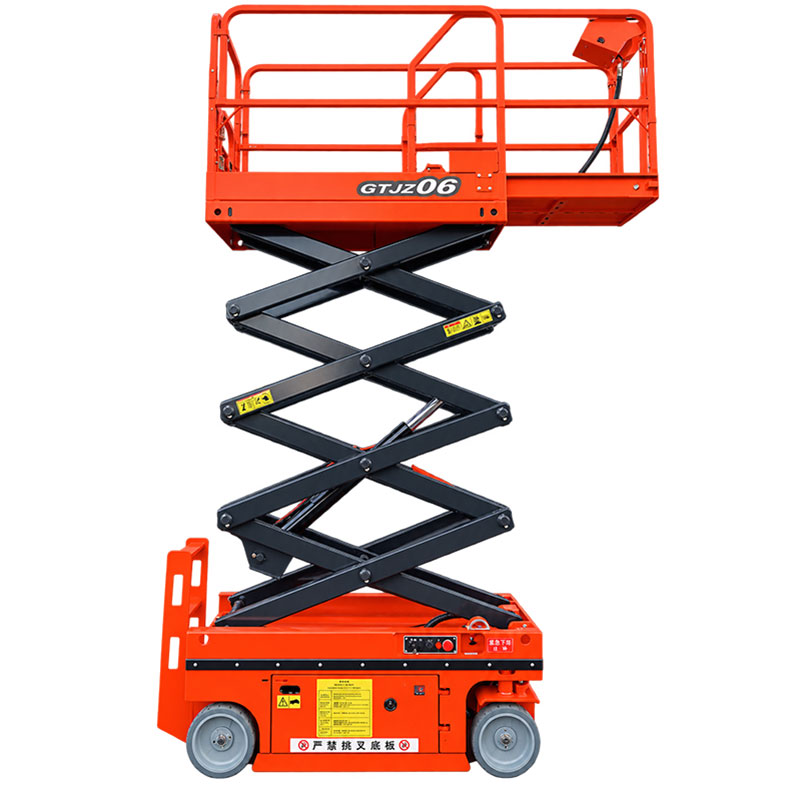
6m scissor lift is a versatile choice for warehouses, manufacturing plants and commercial facilities that require regular access above normal maintenance height without using a large aerial platform.
This height equipment sits between ultra-compact low-level equipment and larger construction-oriented machines. The key purchasing question is not simply whether the machine can reach 6 meters. It is whether the equipment can move efficiently through the facility where it will be used.
| Model | GTJZ06 |
| Max. Working Height | 7.8 m |
| Max. Platform Height | 5.8 m |
| Safe Working Load | 230 kg |
| Extension Platform Capacity | 113 kg |
| Platform Size | 1.67 × 0.74 × 1.10 m |
| Platform Extension | 0.90 m |
| Overall Dimensions (L × W × H) | 1.85 × 0.80 × 2.22 m |
| Height with Guardrails Folded | 1.85 m |
| Wheelbase | 1.36 m |
| Drive Speed (Stowed) | 3.5 km/h |
| Gradeability | 25% |
| Lifting Motor | 24 V / 3.3 kW |
| Battery | 4 × 12 V / 80 Ah |
| Machine Weight | Approx. 1,620 kg |
Leave more about your requirements, like models, quantities, countries, etc.
Warehouses contain racks, loading areas, narrow passages and changing traffic patterns.
A 6m scissor lift used in this environment must be easy to maneuver.
Important considerations include chassis width, steering angle, turning radius and travel control response.
The machine may need to move between storage zones several times during a shift.
For this reason, self-propelled electric configurations are commonly considered for warehouse applications.
They allow operators to relocate the platform without relying on additional personnel to push or tow the machine.
The available aisle width should be measured before selecting a model. Warehouse buyers often focus on rated working height and overlook turning space.
However, a machine that reaches the required height but cannot turn between racks creates operational problems. Check the complete machine dimensions in both transport and operating configurations.
Pay particular attention to any extension deck, guardrail system or protruding components.
For busy warehouses, smooth steering and predictable travel speed are also important.
Battery-electric drive is well suited to enclosed warehouse and factory environments. It supports quieter operation and does not generate direct exhaust emissions from an internal combustion engine during use.
Many warehouse floors have polished or coated concrete surfaces. Non-marking tires help reduce visible marks and contamination on finished floors. This feature can be especially valuable in clean logistics environments, food-related facilities and modern distribution centers.
Compared with ladders, a scissor lift allows operators to bring more equipment to the working position. For industrial maintenance, this can include hand tools, testing equipment, installation materials and replacement components. Buyers should therefore evaluate platform dimensions in addition to rated capacity.
If two technicians regularly work together, platform space becomes even more important. An extension deck may improve access to work points without requiring the entire machine to be repositioned.
Warehouse floors are usually designed for substantial loads, but machine weight should still be checked carefully. This becomes especially important when the lift operates on mezzanine floors, elevated warehouse areas, loading platforms or older industrial structures. The total equipment weight and wheel loading should be compared with site limitations.
Leave more about your requirements, like models, quantities, countries, etc.
Warehouses increasingly contain electrical, fire protection and automation systems installed above operating areas. A 6m machine can support maintenance involving lighting systems, sprinkler lines, CCTV equipment, sensors, signage, wiring, ventilation components and rack-related installations.
The platform gives workers space to carry tools and small components to the working position. This makes it suitable for maintenance teams responsible for multiple systems inside the same facility.
Yes, if the machine width and turning radius are compatible with the aisle layout. Measuring the narrowest aisle and turning area before purchase is essential.
Possibly, but machine weight and wheel loading must be checked against the structural load limit of the mezzanine.
Battery capacity becomes increasingly important when the machine travels frequently between work areas. High travel frequency can consume more energy than occasional stationary lifting.
An extension deck can improve access to work areas located slightly beyond the chassis footprint. Buyers should confirm both extension length and permitted deck load.
They are often preferred where floor appearance, cleanliness or production hygiene matters, although the requirement depends on the facility.
Useful information includes aisle width, door size, floor type, operating height, expected load, working hours and available charging voltage.