
Would Like the Latest Price?
Leave more about your requirements, like models, quantities, countries, etc.
Electric pipe bender is a motor-powered industrial tool designed to bend metal conduits, stainless steel pipes, copper tubes, and galvanized pipes into accurate angles without wall wrinkling, cracking, or flattening. It converts the rotational power of the motor into mechanical thrust and bending force through transmission structures, realizing cold bending processing of various tubular materials. They can accurately complete fixed-angle bending, arc bending, and U-shaped bending for pipes of different calibers, effectively solving the problems of uneven bending, pipe cracking, and low efficiency caused by manual operation. The equipment is suitable for thin-wall and thick-wall pipes within a specific diameter range, with strong compatibility for industrial and civil pipe processing scenarios. Whether you need simple 90-degree bends, offsets, saddles, or complex multi-angle tube forming, electric pipe bender for sale in our company streamlines on-site and factory pipe processing for both small DIY projects and large-scale commercial construction.
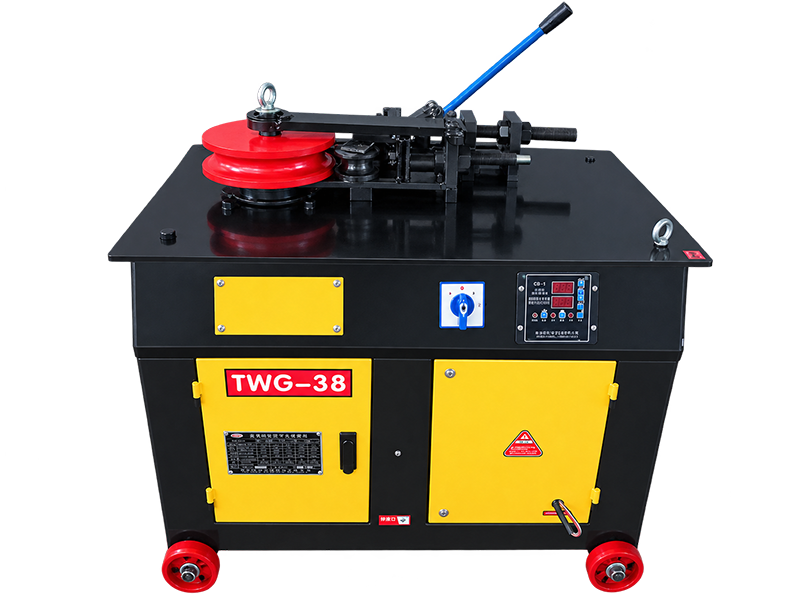
| Parameters | TWG-25 | TWG-38 | TWG-50 | TWG-75 |
| Power | 1.1KW-6 | 3KW-4 | 4KW-4 | 4KW-4 |
| Round tube | ≤φ25*2.5 | ≤φ38*2 | ≤φ50*2.5 | ≤φ75*2.5 |
| Square tube | ≤20X20X3 | ≤30X30X3 | ≤40X40X3 | ≤60X60X3 |
| Speed | 12r/min | 10r/min | 8r/min | 6r/min |
| Angle | ≤180° | ≤180° | ≤180° | ≤180° |
| Bend angle number | 9 | 9 | 9 | 9 |
| Size | 90X60X90mm | 100X70X90mm | 100X82X90mm | 140X90X96mm |
| Weight | 140KG | 230KG | 310KG | 390KG |
Leave more about your requirements, like models, quantities, countries, etc.
Electric pipe benders adopt advanced motor-driven cold bending technology, relying on pure mechanical or electric-hydraulic combined transmission to complete pipe forming without high-temperature heating. The core working process includes power output, mechanical transmission, precise positioning, and pressure forming.
First, the device’s motor starts and outputs rotational torque, which is transmitted to the reduction gearbox to reduce speed and increase torque, providing stable and powerful bending power.
Then, the transmission mechanism pushes the bending die and roller to clamp the fixed pipe tightly, fixing the pipe on the operating platform to prevent displacement. According to the preset bending angle and radian, the driving mechanism drives the bending die to rotate at a uniform speed, exerting continuous and uniform pressure on the pipe. Under the action of external mechanical force, the pipe produces plastic deformation, forming a standard bending radian.
Finally, the equipment resets automatically after reaching the set angle, completing one bending cycle. The whole process avoids high-temperature heating, ensuring the original physical properties and structural strength of the pipe material remain unchanged.
This is the power core of the equipment, mainly including a high-power motor, reduction gearbox and power control switch. The motor provides basic rotational power, while the reduction gearbox converts high-speed low-torque power into low-speed high-torque power, meeting the pressure demand of thick pipe bending. The power control system supports jogging and continuous operation modes to adapt to different processing needs.
The die group is the key forming component, including customized bending dies and limit rollers of different specifications. The die fits the pipe’s outer diameter perfectly to avoid pipe extrusion and deformation. The positioning roller fixes the pipe’s horizontal position during operation, ensuring no offset during bending and guaranteeing consistent bending radian of each pipe.
The intelligent control panel is responsible for parameter setting and operation control. Users can preset bending angles, working speed and reset parameters through the panel. High-end models are equipped with digital display screens to show real-time working data, which is convenient for precise adjustment and standardized operation.
The bending arm is the executive component of bending force, made of high-strength alloy steel with strong compression resistance and wear resistance. It drives the die to rotate and bend, bearing the main mechanical pressure during operation, and effectively preventing structural deformation after long-term continuous work.
The heavy-duty fixed base stabilizes the whole equipment to avoid vibration and displacement during high-power operation. The anti-slip limit structure on the base further improves the stability of pipe placement, laying a foundation for high-precision bending processing.
It includes overload protection, emergency stop switch and overheat protection modules. When the equipment is overloaded, blocked or overheated, the system will automatically cut off the power to avoid motor burnout and equipment damage, ensuring operation safety.
Leave more about your requirements, like models, quantities, countries, etc.
Relying on electric precise control and fixed die positioning, the bending angle error is controlled within ±0.5°, effectively avoiding the problems of uneven radian and angle deviation in manual bending. The processed pipes meet national and industrial installation standards and can be directly used in engineering assembly.
Compared with manual bending, the working speed is increased by 3-5 times. A single bending operation can be completed in a few seconds, and continuous batch processing is supported, greatly shortening the pipe processing cycle and improving the overall construction progress of engineering projects.
The electric drive mode does not rely on manual force. A single worker can complete the operation independently, reducing the dependence on manual physical strength. It solves the problem of high labor intensity and low output of traditional bending work, saving long-term labor costs for enterprises.
Adopting cold bending forming technology and customized flexible dies, it will not damage the pipe surface, cause pipe wall thinning, cracking or wrinkling. It can well protect the structural integrity and anti-corrosion performance of metal and plastic pipes.
It supports the processing of various pipe materials including steel pipes, iron pipes, stainless steel pipes, PVC pipes and aluminum alloy pipes, covering pipe diameter specifications from small caliber to large caliber. It can adapt to multiple scenarios of civil construction and industrial production.
Equipped with multiple safety protection mechanisms such as overload protection and emergency stop power-off. The equipment runs stably with low failure rate, avoiding safety accidents such as pipe popping and tool damage during manual bending.
Leave more about your requirements, like models, quantities, countries, etc.
The core difference lies in power source, working efficiency and bending accuracy. Manual pipe benders rely entirely on human force, with low efficiency, large angle error and high labor intensity, only suitable for occasional small-batch processing. Electric pipe benders are driven by motors, featuring automatic operation, high bending accuracy within ±0.5°, 3-5 times higher efficiency than manual tools, and stable processing quality. They can adapt to long-term batch work and various high-standard engineering scenarios that manual tools cannot meet.
Electric pipe benders have certain applicability limitations and cannot bend all pipes indiscriminately. They are suitable for conventional metal pipes such as steel pipes, iron pipes, stainless steel pipes, aluminum pipes and plastic pipes like PVC and PE pipes with regular shapes and uniform pipe walls. However, they cannot process severely corroded, cracked, uneven-thickness pipes, as well as ultra-hard alloy pipes and special-shaped pipes beyond the equipment’s diameter and pressure bearing range.
Standard cold bending operation of electric pipe benders will not damage the basic performance of qualified pipes. Cold bending forms plastic deformation through uniform mechanical pressure without high-temperature heating, which will not change the pipe’s material properties, structural strength and anti-corrosion performance. Only non-standard operations such as over-bending, rapid bending and overload processing will cause pipe wall thinning and internal structural damage, affecting the pipe’s service life and safety.
First, select a die that perfectly matches the pipe diameter to avoid gaps and offset.
Second, calibrate the equipment angle regularly before operation to eliminate systematic errors.
Third, control the bending speed uniformly and avoid fast and slow intermittent operation.
In addition, fix the pipe firmly to prevent displacement during bending, and choose appropriate processing parameters according to different pipe materials to ensure consistent bending radian each time.
Most electric pipe benders can complete U-shaped, arc-shaped, right-angle and multi-angle conventional bends by adjusting parameters and replacing different dies. Ordinary portable models are suitable for simple U-shaped and fixed arc bending, while CNC automatic models support complex multi-section arc bending and irregular shaped bending. Users only need to set the corresponding angle and radian parameters to realize diversified pipe forming processing.
Pipes with poor ductility and fragile structures are not suitable for electric cold bending, including ultra-thick high-hardness alloy pipes, severely rusted and corroded pipes, brittle cast iron pipes, and pipes with wall thickness unevenness and internal cracks. These pipes are prone to cracking, breaking and structural damage during bending, which cannot meet engineering use standards and may even cause equipment failure and safety accidents.
Model selection needs to be based on actual processing needs.
For on-site construction and small-batch processing of small-diameter pipes, choose lightweight portable models.
For factory standardized medium-batch processing, select desktop electric pipe benders.
For large-scale industrial production and complex bending processes, choose CNC automatic models.
For large-diameter thick-wall industrial pipes, match heavy-duty high-power models to ensure processing efficiency and effect.
For most civil and small industrial scenarios, electric pipe benders are more cost-effective. They have lower equipment purchase and maintenance costs, simpler operation, no need for complex hydraulic oil maintenance, and lower failure rate. Hydraulic pipe benders are only superior in processing ultra-large thick-wall pipes. For conventional pipe bending work, electric models save labor and maintenance costs, with higher comprehensive cost performance and wider application range.
Pipe cracking during bending is mainly caused by improper operation and mismatched parameters. The common reasons include too fast bending speed, excessive bending angle exceeding the pipe’s ductility limit, unqualified pipe material with poor toughness, and mismatched die size leading to excessive pipe extrusion. In addition, processing cold and brittle pipes in low-temperature environments will also greatly increase the cracking probability. Adjusting parameters and matching suitable dies can effectively avoid this problem.
All formal electric pipe bender models support standard 90-degree right-angle bending and can achieve smooth and flawless right-angle forming through precise parameter setting and matched molds. The mechanical uniform pressure design prevents pipe wall collapse and arc distortion at the bending corner. Users only need to preset 90 degrees on the control panel, and the machine will automatically complete stable forming, which fully meets the installation requirements of electrical conduits and water pipe layouts.