
Vegetable
Freeze Dryer
Vegetable freeze dryer can be used to help households process suitable vegetables into lightweight ingredients for future meals. From seasonal garden produce to vegetables purchased in larger quantities, a small home freeze dryer provides another way to organize food into useful portions.
Unlike a conventional hot-air dryer, a vegetable freeze dryer removes moisture from frozen food under vacuum. The finished result depends on the vegetable, preparation method, loading arrangement, and drying cycle.
Guigong Machinery supplies small vegetable freeze dryers for household applications. If you are looking for a vegetable freeze drying machine, start with the vegetables you plan to process, your expected batch size, and the installation space available. These details provide a practical basis for comparing suitable models.
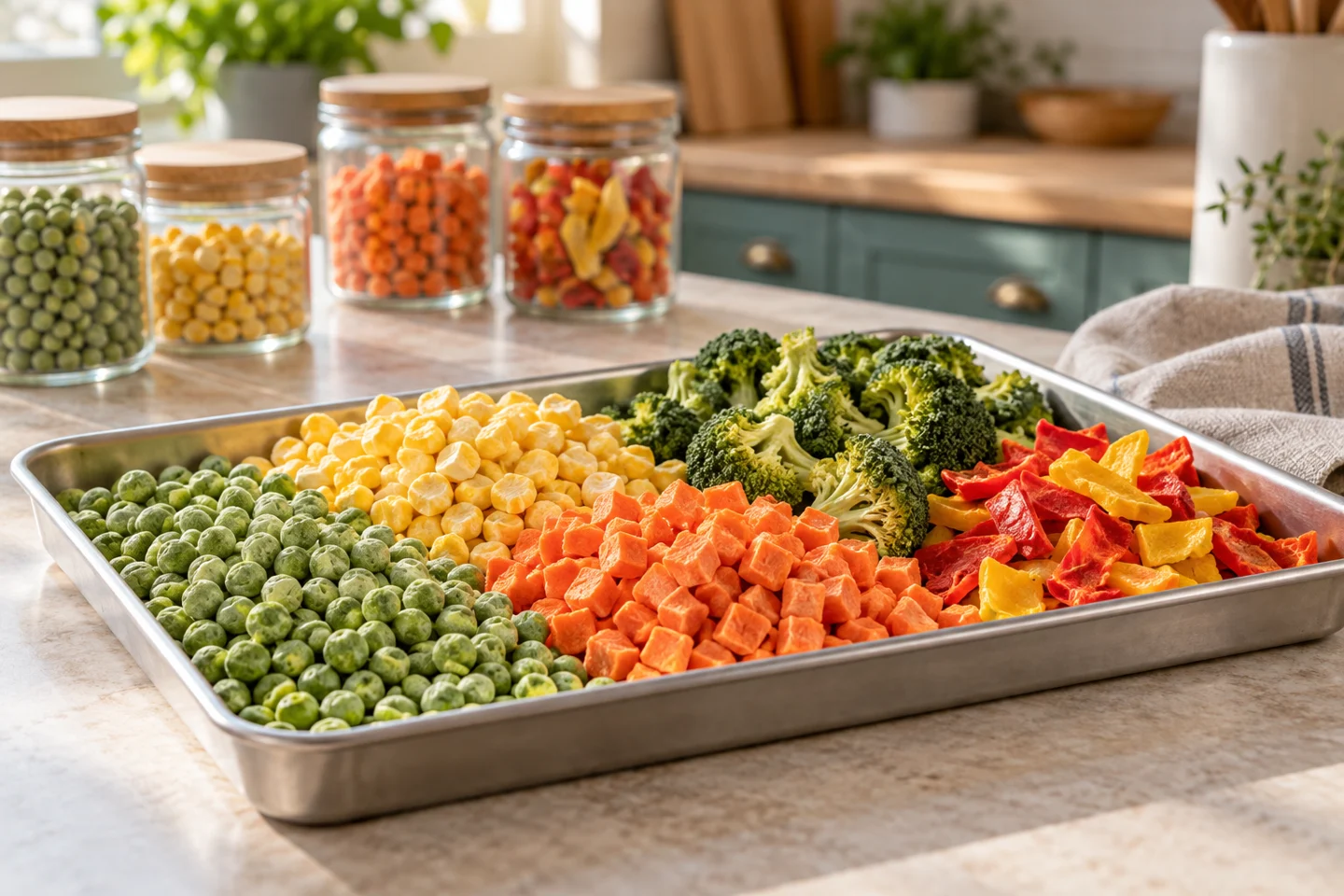
to your next recipe.Illustrative vegetable preservation scene

What Is a Vegetable Freeze Dryer?
A vegetable freeze dryer is a food freeze-drying machine used to process prepared vegetables. It generally combines a refrigerated drying chamber, food trays, a vacuum system, and operating controls.
Freeze-drying involves freezing the food, removing ice through sublimation under vacuum, and reducing remaining moisture during further drying. Sublimation allows ice to change directly into water vapor without first becoming liquid water.
For buyers, “vegetable freeze dryer” normally describes an application of a home food freeze dryer rather than a machine restricted exclusively to vegetables. Depending on its specifications and instructions, the same equipment may also process suitable fruits and other foods.
The important question is whether the selected model can accommodate your intended vegetables, loading method, and operating routine.
Why Use a Small Freeze Dryer for Vegetables?
A household vegetable freeze dryer is most useful when it fits the way you buy, grow, prepare, and cook food.
Process Seasonal Garden Produce
Home gardens can produce more vegetables than a household can immediately consume. Freeze-drying provides an additional processing option for suitable produce.
Planning is important during a concentrated harvest. Consider the amount of prepared vegetables you can load per batch and the time needed for preparation, processing, unloading, and cleaning.
Prepare Ingredients in Convenient Portions
Vegetables can be prepared in forms suited to future recipes, such as carrot pieces, peas, corn kernels, or chopped greens.
Packaging these ingredients in recipe-sized portions makes them easier to organize. For example, separate portions may be prepared for soups, stews, rice dishes, or camping meals.
Reduce Reliance on Continuous Freezer Storage
Properly processed and appropriately packaged freeze-dried vegetables may be suitable for room-temperature storage. However, successful storage depends on adequate drying, food handling, packaging, and storage conditions.
A vegetable freeze dryer should therefore be considered part of a complete preservation process. The machine alone does not establish the storage life of the finished food.
Explore Different Vegetable Products
Some users want lightweight cooking ingredients, while others are interested in vegetable powders or selected crisp products.
Define your intended result before choosing equipment. A vegetable intended for soup does not need the same eating texture as a snack, and not every vegetable produces an appealing ready-to-eat product.
Which Vegetables Can You Freeze Dry?
Many vegetables are candidates for home freeze-drying, but preparation requirements and finished quality vary. The following examples are useful starting points for discussing an application with your vegetable freeze drying machine supplier.
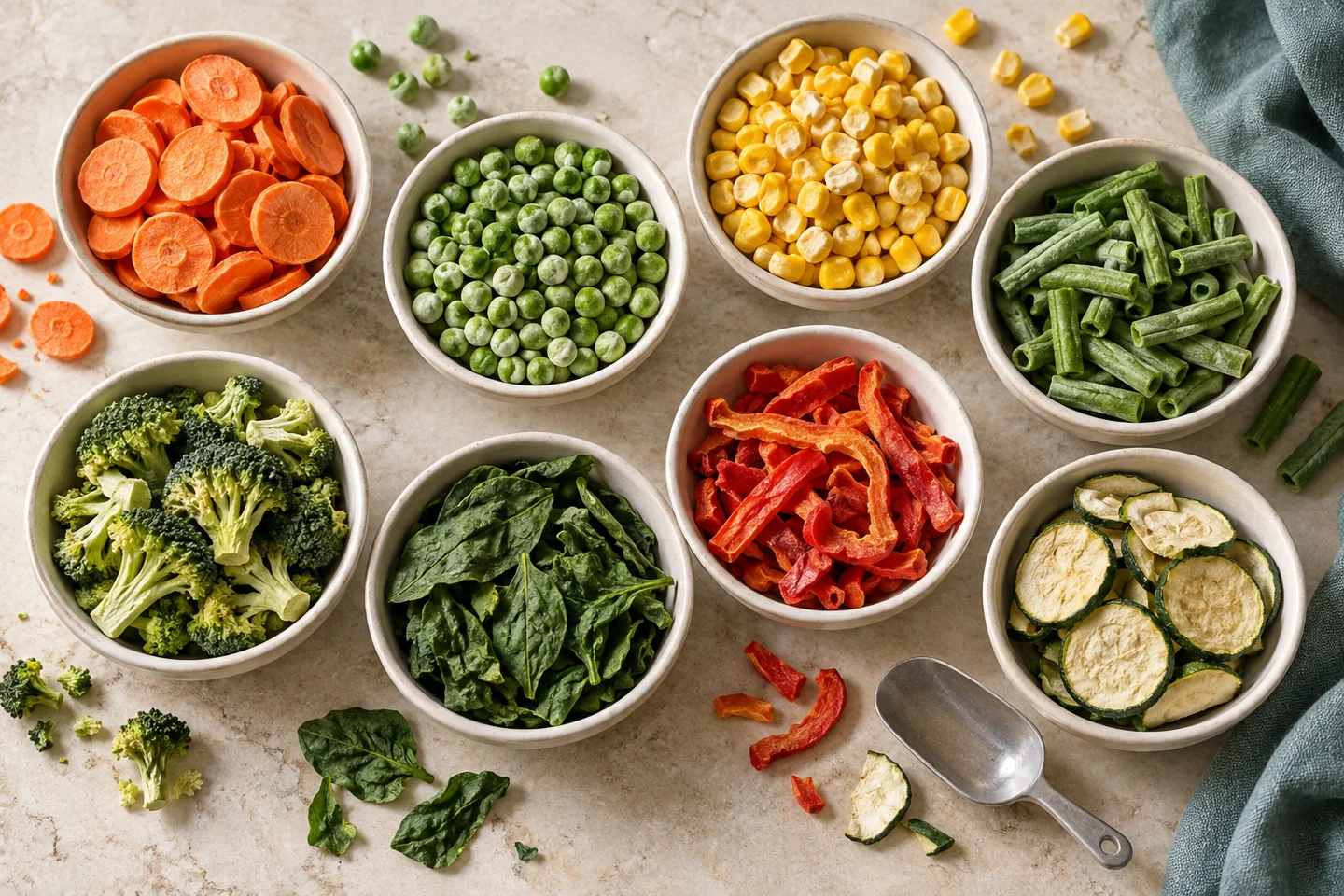
| Vegetable | Possible preparation form | Intended use | Points to evaluate |
|---|---|---|---|
| Carrots | Uniform slices or small pieces | Soups, stews, mixed vegetables | Piece thickness and appropriate pretreatment |
| Peas | Shelled peas | Rice dishes, soups, meal ingredients | Preparation guidance and even loading |
| Sweet corn | Prepared kernels | Soups, cooking ingredients, selected snacks | Appropriate pretreatment and loading depth |
| Green beans | Trimmed, uniform pieces | Soups and cooked dishes | Piece size and recommended preparation |
| Broccoli | Small, evenly sized florets | Soups and prepared meals | Variation between stems and florets |
| Spinach | Prepared leaves or portions | Soups, sauces, ingredient blends | Low bulk density and tray arrangement |
| Bell peppers | Strips or small pieces | Seasoning blends and cooked meals | Consistent cutting and intended texture |
| Zucchini | Uniform slices or pieces | Soups and mixed dishes | High water content and loading arrangement |
This table is an application overview, not a set of validated processing instructions. You should follow reliable guidance for each vegetable and the operating instructions for the selected machine.
For initial trials, process one vegetable at a time. This makes it easier to understand how preparation and loading affect the result.
How to Prepare Vegetables for Freeze-Drying
Choose sound produce, prepare consistent pieces and follow vegetable-specific instructions.
Select Sound, Good-Quality Produce
Begin with vegetables suitable for consumption. Remove damaged portions and discard spoiled produce.
Freeze-drying does not restore deteriorated vegetables or make unsafe ingredients suitable to eat.
Wash and Trim Appropriately
Wash vegetables using appropriate food-handling practices. Remove soil, unwanted stems, tough sections, and other inedible material.
Keep preparation surfaces, utensils, and trays clean, especially when handling several ingredients.
Cut Vegetables into Consistent Pieces
Uniform cutting helps reduce variation within a batch. Large differences in thickness can make it more difficult to assess whether all pieces have dried adequately.
Choose a preparation form that matches both the machine’s loading guidance and the food’s intended use.
Follow Vegetable-Specific Blanching Guidance
Many vegetables require blanching before preservation to control enzyme activity and support quality. The method and timing depend on the vegetable and preparation size.
Use reliable vegetable-specific instructions rather than applying one blanching time to every ingredient.
Arrange Food According to Loading Instructions
Spread prepared vegetables in the recommended arrangement and avoid exceeding the specified loading depth.
Packing more food onto a tray may increase the fresh weight loaded, but it does not necessarily improve useful output. Loading must remain within the machine’s operating guidance.
How to Choose a Vegetable Freeze Dryer for Home Use
Check Fresh Food Loading Capacity
Ask what the stated capacity represents. Fresh vegetable input, finished dried output, and ice collection capacity are different measurements.
Also ask which vegetable and loading arrangement were used to establish any reference capacity. A load demonstrated with one food should not automatically be applied to every other vegetable.
Compare Usable Tray Area
Tray dimensions are particularly relevant when processing sliced vegetables that need to be spread across the surface.
A machine with more trays does not necessarily provide more usable area than another model with fewer, larger trays. Compare:
- Tray length and width.
- Total usable loading area.
- Space between trays.
- Recommended food depth.
- Access for loading and removal.
For leafy vegetables, usable space and loading arrangement may matter more than a headline weight figure.
Confirm Installation Space
Allow room for the main unit, any separate vacuum pump, door opening, tray removal, and maintenance access.
Follow the vegetable freeze dryer manufacturer’s clearance and ventilation requirements. Check the supporting surface and delivery route before ordering.
Review Electrical Requirements
Confirm voltage, frequency, electrical input, plug type, and circuit requirements for the actual model.
Overseas buyers should provide local power-supply details before the configuration is finalized.
Understand Pump Maintenance
Ask which vacuum pump is included and what routine care it requires.
For an oil-lubricated pump, confirm oil specifications and maintenance procedures. If another pump configuration is offered, request its servicing requirements and spare-part information.
Request Relevant Application Information
A useful reference test should identify the vegetable, prepared loading weight, piece size, loading depth, and operating conditions.
Photographs of finished vegetables can help illustrate appearance, but they should be supported by enough information to understand how the result was obtained.
Technical Specifications of Vegetable Freeze Dryers
Compare loading capacity, tray dimensions, installation size and electrical requirements across five models.
| Model | HFD-1 | HFD-4 | HFD-6 | HFD-8 | HFD-15 |
|---|---|---|---|---|---|
| Freeze-drying area | 0.1 m² | 0.4 m² | 0.6 m² | 0.92 m² | 1.45 m² |
| Cold trap temperature | −50°C | −50°C | −50°C | −50°C | −60°C |
| Processing capacity | 1–2 kg/batch | 4–6 kg/batch | 6–8 kg/batch | 10–12 kg/batch | 18–20 kg/batch |
| Ultimate vacuum | Below 2 Pa | Below 2 Pa | Below 2 Pa | Below 2 Pa | Below 2 Pa |
| Material tray size | 145 × 275 mm | 200 × 425 mm | 315 × 430 mm | 265 × 430 mm | 265 × 780 mm |
| Number of trays | 3 | 4 | 4 | 8 | 7 |
| Tray spacing | 43 mm | 45 mm | 70 mm | 38 mm | 43 mm |
| Pumping speed | 2–4 L/s | 2–4 L/s | 2–4 L/s | 2–4 L/s | 2–4 L/s |
| Water harvesting ability | 3 kg/24h | 4 kg/24h | 6 kg/24h | 10 kg/24h | 18 kg/24h |
| Operating noise | ≤60 dB | ≤60 dB | ≤60 dB | ≤60 dB | ≤60 dB |
| Supply voltage (110V or 380V customizable) | 220V/50Hz | 220V/50Hz | 220V/50Hz | 220V/50Hz | 220V/50Hz |
| Machine dimensions | 450 × 500 × 825 mm | 500 × 640 × 900 mm | 680 × 640 × 1180 mm | 680 × 640 × 1180 mm | 680 × 990 × 1180 mm |
| Net weight | 73 kg | 84 kg | 125 kg | 130 kg | 186 kg |
Processing capacity (kg/batch) and water harvesting ability (kg/24h) are different measurements. Actual food loading and cycle time depend on the ingredient, preparation and operating conditions. Confirm specifications and electrical options for the quoted model.
FAQs About Vegetable Freeze Dryers
From leafy greens to prepared frozen vegetables, compare the requirements that matter for your household.
Discuss your application ↗Do I need a dedicated freeze dryer machine for vegetables?
Not necessarily. A suitable home food freeze dryer may process vegetables as well as other compatible foods. Check the selected model’s intended applications and instructions. The term “vegetable freeze dryer” usually identifies the intended use rather than an entirely separate category of household equipment.
What size vegetable freeze dryer should I choose?
Base your choice on prepared food weight, usable tray area, available space, and operating frequency. If you grow vegetables, consider your busiest harvest period. Ask for loading guidance relevant to your main vegetables instead of selecting a model solely by its maximum advertised capacity.
Can I freeze dry leafy vegetables by a vegetable freeze drying machine?
Leafy vegetables are potential applications, but their low bulk density makes loading arrangement important. Compare usable tray space and follow preparation instructions. Start with a small trial to assess handling, drying consistency, and whether the finished product suits your intended recipe or ingredient use.
Should vegetables be blanched first before freeze-drying?
Many vegetables benefit from or require blanching as part of recommended preservation preparation. Requirements vary, so follow reliable guidance for the specific vegetable. Do not assume that the same method and time apply to leafy greens, corn, carrots, and other vegetables.
Can different vegetables be processed together?
Check the machine guidance and the preparation needs of each ingredient. Different vegetables may dry differently, and mixing them can complicate assessment. Processing one vegetable at a time is useful when establishing an initial routine. Consider strong aromas and allergen handling when organizing batches.
Can I freeze dry vegetables that are already frozen?
This may be suitable where permitted by the freeze drying machine instructions. Confirm that the vegetables have received appropriate preparation and remained safely handled. Follow loading and cycle guidance for frozen food rather than assuming that every frozen product can be processed in the same way.
Will freeze-dried vegetables be identical to fresh vegetables?
No preservation method guarantees an identical result for every ingredient. Evaluate color, aroma, texture, and performance in the intended recipe. Some vegetables may work well in cooked dishes while being less appealing as standalone snacks. Trial batches help establish realistic expectations.
How should I compare vegetable freeze dryer quotations?
Compare the same supply scope: model, tray dimensions, pump, electrical configuration, accessories, packing, delivery terms, warranty, and documentation. Ask vegetable freeze dryer suppliers to explain the basis of capacity figures. A lower machine price may exclude components or services included in another quotation.
Buy Small Vegetable Freeze Dryers from Guigong Machinery
Guigong Machinery supplies small food freeze dryers for household applications, including suitable vegetable-processing requirements.
To discuss an appropriate model, provide more than the name of the vegetable. Explain how you intend to prepare it and what you want the finished product to do.
Useful enquiry details include:
- Main vegetables to be processed.
- Approximate prepared weight per batch.
- Expected frequency of use.
- Preferred finished form.
- Installation-space limits.
- Destination country and electrical supply.
Before ordering, request confirmation of the model specifications, included pump and accessories, operating documentation, maintenance requirements, packing, delivery terms, and warranty.