
Would Like the Latest Price?
Leave more about your requirements, like models, quantities, countries, etc.
A medium frequency induction heating equipment is an industrial induction heating system designed to heat electrically conductive metals using electromagnetic induction. Compared with higher-frequency induction heating equipment, medium frequency systems are commonly selected when an application requires relatively deep heating, rapid temperature increase, stable heating, and efficient processing of medium-sized or larger metal workpieces.
Medium frequency induction heating equipment is widely used for metal forging, induction hardening, annealing, tempering, preheating, shrink fitting, and other industrial heating processes. The appropriate frequency and power depend on the workpiece material, dimensions, required heating depth, target temperature, heating time, and production capacity.
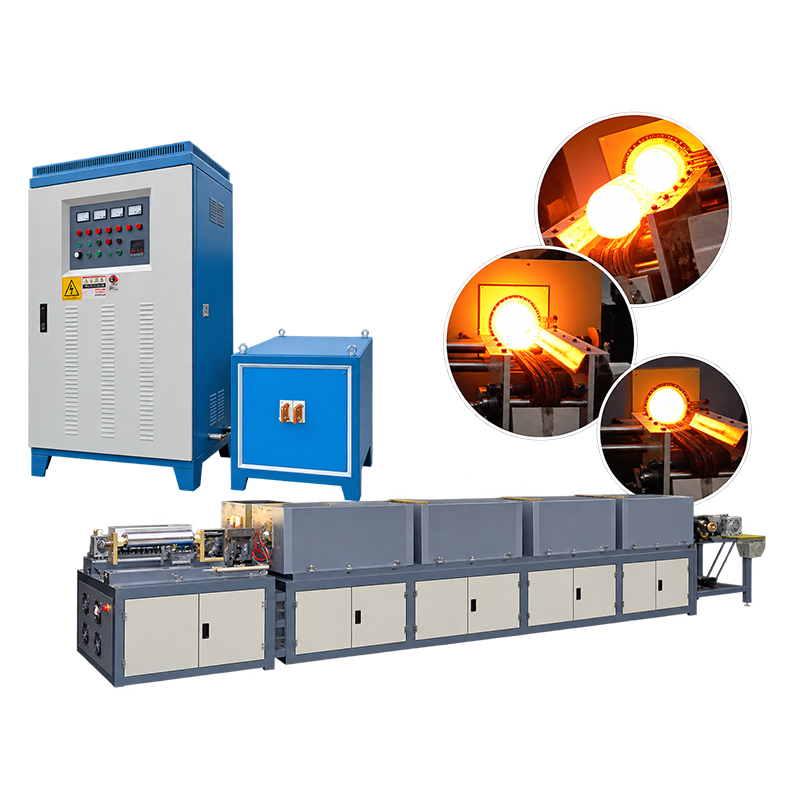
| Items | LSW-200 | LSW-300 | LSW-400 | LSW-500 |
| Working voltage | 380V, 50/60Hz | 380V, 50/60Hz | 380V, 50/60Hz | 380V, 50/60Hz |
| Voltage range | 340–420V | 340–420V | 340–420V | 340–420V |
| Max input current | 320A | 480A | 620A | 780A |
| Max input power | 200KW | 300KW | 400KW | 500KW |
| Oscillation frequency | 1–8KHz | 1–8KHz | 1–8KHz | 1–8KHz |
| Duty cycle | 100% | 100% | 100% | 100% |
| Cooling water flow (Power supply cabinet) | 50L/Min, 0.2MPa | 60L/Min, 0.2MPa | 80L/Min, 0.2MPa | 90L/Min, 0.2MPa |
| Cooling water flow (Transformer cabinet) | 50L/Min, 0.2MPa | 60L/Min, 0.2MPa | 80L/Min, 0.2MPa | 90L/Min, 0.2MPa |
| Weight (Power supply cabinet) | 180kg | 190kg | 240kg | 280kg |
| Weight (Transformer cabinet) | 200kg | 300kg | 360kg | 450kg |
| Dimension (Power supply cabinet) (L×W×H) | 1070×640×1870mm | 1070×640×1870mm | 1200×760×2060mm | 1200×760×2060mm |
| Dimension (Transformer cabinet) (L×W×H) | 870×530×600mm | 1020×530×690mm | 1150×530×690mm | 1150×530×690mm |
Leave more about your requirements, like models, quantities, countries, etc.
Determine the Workpiece Material. Provide the supplier with the exact material or material grade.
Determine the Workpiece Dimensions. Like diameter, length, thickness, width, weight, shape, etc.
Determine the Target Temperature. Forging, hardening, annealing, tempering, and preheating require different process conditions.
Determine the Required Heating Depth. The required heating depth is particularly important when selecting the operating frequency.
Determine the Heating Time. If a workpiece must reach a target temperature within a short cycle, the required power may be significantly higher.
Determine Production Capacity. A machine designed for laboratory testing or small-batch production will have different requirements from a continuous forging production line.
Leave more about your requirements, like models, quantities, countries, etc.
Yes. Medium frequency induction heating can be used for suitable stainless steel grades. Because stainless steel grades have different electrical, thermal, and magnetic properties, the required power, frequency, coil configuration, and heating time may vary. Testing the actual material is recommended for demanding industrial applications.
Yes. Medium frequency induction heating can be used for induction hardening of shafts, gears, sprockets, pins, axles, and other suitable steel components. The heating process is normally followed by quenching, and the final hardness profile depends on material, frequency, power, coil design, heating time, and quenching conditions.
Yes. It can be used for annealing suitable steel and other conductive metals. Depending on the process, induction annealing can reduce hardness, relieve residual stress, improve ductility, or improve machinability. The heating temperature and cooling conditions should be established according to the material and required metallurgical result.
Yes. Medium frequency induction heating equipment can be used for tempering after hardening. It provides controlled heating to the required tempering temperature and can be integrated with hardening and quenching equipment in an automated heat treatment production line.
Yes. Medium frequency systems can be suitable for many medium-sized and large metal workpieces. However, larger components generally require appropriate power, coil dimensions, cooling capacity, and heating time. The equipment should be selected based on actual workpiece and production requirements.
Yes. It can be integrated with automatic feeding, conveyors, robotic handling, temperature measurement, quenching systems, forging presses, and PLC controls. Automation is particularly useful for continuous manufacturing and high-volume production.
Yes. Induction coils can be designed according to the workpiece geometry, heating area, required heating depth, production method, and process requirements. Proper coil design is important for energy transfer, heating efficiency, and temperature uniformity.
Power depends on workpiece material, weight, dimensions, target temperature, heating time, production rate, heat losses, and system efficiency. A larger workpiece or shorter heating cycle normally requires greater heating capacity. Power should therefore be calculated from the complete process.
The difference between medium and high frequency induction heating is primarily related to the operating frequency and its effect on heating distribution.
In general, increasing frequency tends to concentrate induced current and heating closer to the surface. Lower frequencies can support greater penetration into a suitable workpiece.
High frequency induction heating is therefore commonly considered for applications such as: surface hardening, brazing, soldering, localized heating, small components.
Medium frequency induction heating is often considered when the application requires: greater heating depth, heating of larger components, more substantial cross-sectional heating, forging, heat treatment.
The correct frequency depends on material properties, workpiece geometry, required heating depth, target temperature, heating time, and production requirements.
First, the induction heating power supply receives electrical energy from the electrical grid. The power electronics convert this energy into alternating current at the required frequency.
The current then flows through the induction coil, producing an alternating magnetic field. When a conductive metal workpiece enters this magnetic field, eddy currents are induced inside the workpiece. These currents generate heat within the material.
The distribution of heat is influenced by frequency, electrical resistivity, magnetic properties, workpiece dimensions, coil design, and heating time.