
Would Like the Latest Price?
Leave more about your requirements, like models, quantities, countries, etc.
Hydraulic pipe bender is a mechanical pipe-bending device driven by a hydraulic power unit, designed specifically for cold-forming various rigid tubular materials. It converts hydraulic oil pressure into powerful linear or rotational mechanical force, pushing precision bending dies to deform pipes into preset angles, arcs, and shapes without high-temperature heating. The hydraulic pipe bending machine is engineered to handle heavy-load bending tasks that manual and ordinary electric pipe benders cannot complete, solving common problems such as insufficient power, pipe rebound, wall cracking, and incomplete forming in conventional bending tools. It supports standardized processing of thick-wall steel pipes, stainless steel pipes, galvanized pipes, and industrial alloy pipes, ensuring high structural accuracy and mechanical integrity of finished pipe fittings for engineering and industrial applications.
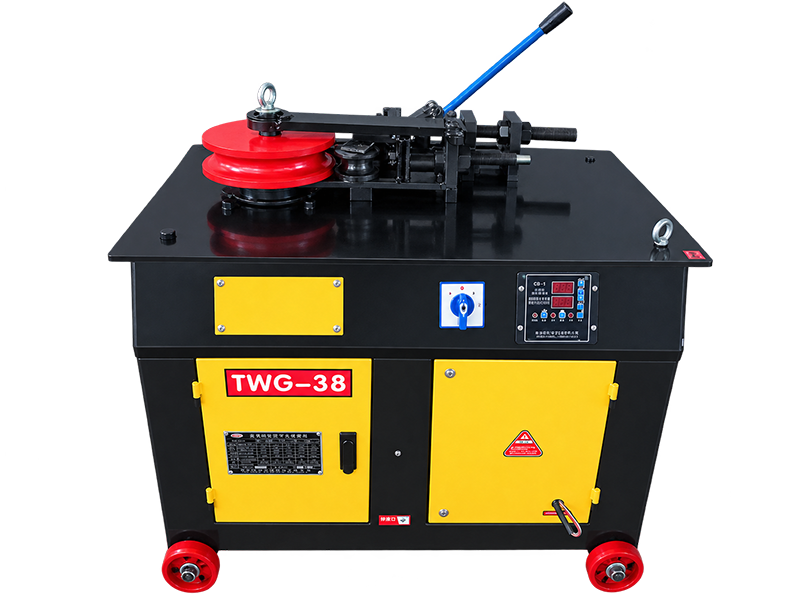
| Parameters | TWG-38 bridge hydraulic | TWG-50 bridge hydraulic | TWG-50 hydraulic CNC | TWG-50 Full hydraulic CNC | TWG-75 hydraulic CNC | TWG-75 Full hydraulic CNC | TWG-108 hydraulic CNC |
| Power | 3KW-4 | 4KW-4 | 4KW-4 | 4KW-4 | 7.5KW-4 | 7.5KW-4 | 9KW-4 |
| Round tube | ≤φ38*2 | ≤φ50*2.5 | ≤φ50*2.5 | ≤φ50*2.5 | ≤φ76*8 | ≤φ76*8 | ≤φ108*2.5 |
| Square tube | ≤30X30X3 | ≤40X40X3 | ≤40X40X3 | ≤40X40X3 | ≤80X80X3 | ≤80X80X3 | ≤90X90X3 |
| Speed | 10r/min | 8r/min | 8r/min | 8r/min | 5r/min | 5r/min | 5r/min |
| Angle | ≤180° | ≤180° | ≤180° | ≤180° | ≤180° | ≤180° | ≤180° |
| Bend angle number | 9 | 9 | 9 | 9 | 9 | 9 | 9 |
| Size | 100X70X90mm | 120X82X90mm | 100X82X90mm | 100X82X90mm | 145X95X96mm | 145X95X96mm | 160X95X90mm |
| Weight | 230KG | 360KG | 330KG | 360KG | 660KG | 660KG |
Leave more about your requirements, like models, quantities, countries, etc.
The working principle of a hydraulic pipe bender centers on hydraulic transmission and static pressure cold bending technology, featuring stable power output and uniform stress on pipes during operation. The entire working process is closed-loop and controllable.
First, the hydraulic power unit starts, and the motor drives the hydraulic pump to pressurize the hydraulic oil, forming stable high-pressure oil flow inside the hydraulic circuit. The pressure oil is delivered to the hydraulic cylinder through control valves, pushing the cylinder piston to generate powerful thrust. The thrust acts on the bending arm and precision die set, firmly clamping and slowly pushing the fixed pipe.
Under continuous, uniform static pressure, the pipe produces plastic deformation without rebound, forming a standard bending radian.
After reaching the preset angle, the hydraulic system releases pressure automatically, and the cylinder resets to complete one bending cycle.
The whole process features low vibration, uniform stress, and no damage to pipe wall structure.
This is the power core of the equipment, composed of a hydraulic pump, oil tank, hydraulic oil filter, heat dissipation device, and control valve group. The hydraulic pump converts electrical energy into hydraulic pressure energy, providing continuous and adjustable high-pressure power for pipe bending. The built-in pressure regulating valve can flexibly adjust hydraulic pressure according to pipe material and wall thickness, avoiding insufficient power or excessive pressure damage to pipes. The heat dissipation structure ensures stable temperature of hydraulic oil during long-time continuous work, preventing power attenuation caused by overheating.
The hydraulic cylinder is the force-executing component, which converts hydraulic pressure into linear mechanical thrust. Equipped with high-precision piston rod and wear-resistant sealing rings, it features strong pressure resistance and no oil leakage. The matching transmission bending arm adopts high-strength integral cast steel structure, which can bear tons of bending pressure without deformation, ensuring stable force transmission and consistent bending effect for each pipe processing.
The die set includes customized bending dies, anti-wear pressure rollers, and limit baffles of different calibers. The inner arc of the die fits the pipe outer diameter perfectly, which can effectively prevent pipe wall wrinkling, flattening, and cracking during high-pressure bending. The adjustable positioning structure can fix pipes of different specifications stably, avoiding displacement and angle deviation in the bending process and greatly improving the forming qualification rate of pipe fittings.
The control system includes manual control switches and digital pressure display modules. Operators can adjust bending speed, hydraulic pressure, and bending angle freely according to processing requirements. Advanced models are equipped with numerical control panels to realize precise parameter memory and one-key forming, supporting batch processing of pipe fittings with the same specification and improving overall working efficiency.
The thickened integral base enhances the overall stability of the equipment, effectively offsetting strong vibration generated by high-pressure operation. It is equipped with hydraulic overload protection, pressure relief reset, and emergency stop devices. When the equipment is overloaded or stuck, the hydraulic system will automatically release pressure to protect the cylinder, motor, and pipe materials from damage, ensuring operational safety and equipment stability.
Leave more about your requirements, like models, quantities, countries, etc.
Relying on hydraulic static pressure transmission, it can generate tons of stable bending thrust, easily bending thick-wall steel pipes and high-hardness alloy pipes. It completely makes up for the power shortage of electric pipe benders and is the only choice for heavy-duty pipe bending work.
The static pressure bending mode ensures uniform stress on the pipe wall without local concentrated pressure. The finished pipe has smooth bending radian, flat inner and outer walls, and almost no elastic rebound, ensuring long-term structural stability of pipe fittings after installation.
It can process almost all conventional metal pipes, including carbon steel pipes, stainless steel pipes, galvanized pipes, alloy pipes, and copper pipes. It adapts to pipe diameters from small 16mm to large 200mm and above, with far wider applicability than ordinary electric pipe benders.
The overall structure is sturdy and wear-resistant, with hydraulic transmission featuring low mechanical loss. Under standardized operation and regular maintenance, the equipment can run stably for a long time, suitable for high-intensity industrial batch production, and has lower long-term failure rate than gear-driven electric pipe benders.
The hydraulic pressure and bending speed can be adjusted steplessly according to pipe hardness and wall thickness, which can effectively protect thin-wall pipes from extrusion deformation and ensure sufficient forming force for thick-wall pipes, realizing one machine for multiple purposes.
Manual hydraulic models require no power supply and are suitable for outdoor field construction, mountain engineering, and power-free operation environments. Electric hydraulic and CNC models adapt to factory standardized production, meeting the processing needs of diverse scenarios.
Leave more about your requirements, like models, quantities, countries, etc.
The core difference lies in the power source and applicable processing scenarios. Hydraulic pipe benders adopt hydraulic static pressure drive with super high bending force, suitable for thick-wall, large-diameter, and high-hardness metal pipes. Electric pipe benders rely on motor torque, with limited power, only for thin-wall and small-diameter pipes. In addition, hydraulic models have smaller pipe rebound and higher forming stability, while electric models have faster speed for light-duty batch processing.
Standard hydraulic cold bending operation can perfectly bend qualified thick-wall steel pipes without cracking or wall wrinkling. The hydraulic system provides uniform and stable static pressure, avoiding local stress concentration caused by instantaneous impact force of electric bending. As long as operators match the correct die size and adjust appropriate hydraulic pressure according to pipe wall thickness, the finished pipe can maintain complete and smooth wall structure.
Manual hydraulic pipe benders are fully applicable to outdoor no-power construction scenarios, as they rely on manual hydraulic pressurization without electric power support. They are lightweight and easy to carry, ideal for field pipeline maintenance, rural engineering, and remote construction sites without power supply. Electric hydraulic models need power supply, so they are more suitable for fixed workshop and indoor construction environments.
Pipe rebound is mainly caused by uneven stress and instantaneous bending force. Hydraulic pipe benders adopt low-speed static pressure bending, which makes the pipe fully produce plastic deformation under continuous and stable pressure, eliminating residual stress inside the pipe. Electric pipe benders use high-speed mechanical rotation bending with instantaneous impact force, leading to partial elastic deformation and obvious rebound, so hydraulic bending has higher forming accuracy.
Hydraulic pipe benders are very suitable for processing high-hardness stainless steel pipes and alloy pipes. These pipes have high material hardness and poor ductility, which are easy to crack when bent by ordinary electric equipment. The adjustable high static pressure of hydraulic systems can slowly deform high-hardness pipes uniformly, ensuring complete pipe wall and standard bending radian, which is the preferred equipment for precision alloy pipe processing.
Ordinary manual and conventional electric hydraulic pipe benders can only complete conventional single-angle and arc bends. Only CNC automatic hydraulic pipe benders support complex multi-angle continuous bending and three-dimensional space bending. Equipped with intelligent programming system, it can store multiple bending coordinates to complete complex shaped pipe processing required by automobile and mechanical manufacturing industries.
Oil leakage is mostly caused by aging sealing rings, loose pipeline joints, or excessive hydraulic pressure.
First, stop the machine and release all residual pressure in the hydraulic system.
Then replace the worn and aging sealing rings and tighten loose oil pipe joints.
Avoid long-term overload pressurization in subsequent use, and regularly check the aging degree of hydraulic accessories to prevent repeated oil leakage problems.
Incomplete pipe forming is mainly due to insufficient hydraulic pressure, oversized die gap, or unstable pipe clamping. When the hydraulic pressure is lower than the deformation resistance of the pipe, the pipe cannot reach the preset bending angle. Loose pipe fixation will cause displacement during pressure application. Users can solve this problem by appropriately increasing hydraulic pressure, replacing matched dies, and strengthening pipe limit fixation.