
Would Like the Latest Price?
Leave more about your requirements, like models, quantities, countries, etc.
A scissor lift is an aerial work platform designed to raise personnel, tools and materials vertically to elevated working positions. With a spacious platform, stable lifting structure and multiple working-height options, scissor lifts are widely used in warehouses, factories, commercial buildings, construction projects and equipment maintenance.
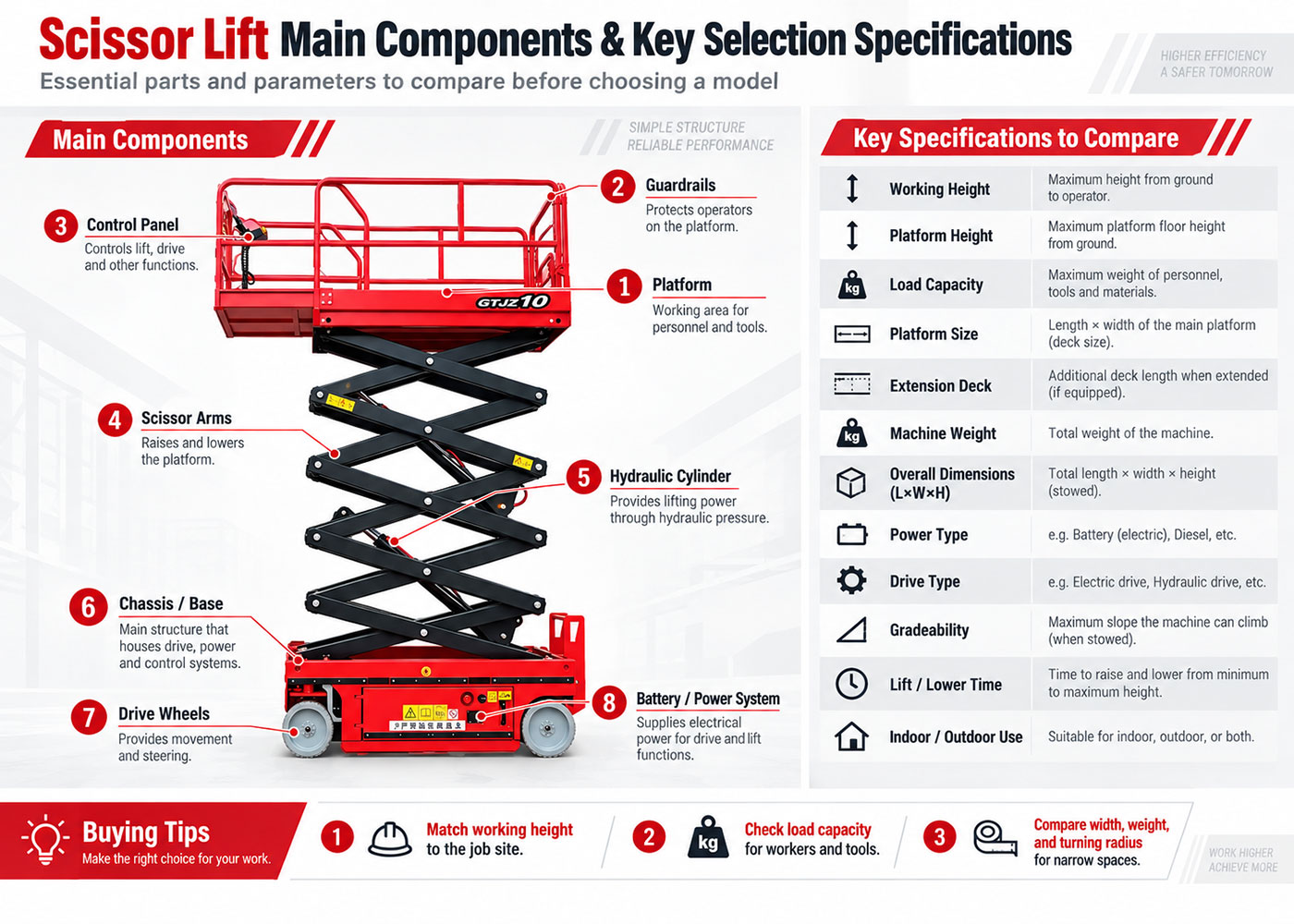
Different working environments require different machine configurations. Compact electric models are suitable for indoor operation on finished floors, while larger rough-terrain machines are designed for demanding outdoor jobsites. When selecting a scissor lift, buyers should look beyond maximum height and compare platform capacity, overall dimensions, power source, drive system, gradeability, machine weight, battery configuration and safety systems.
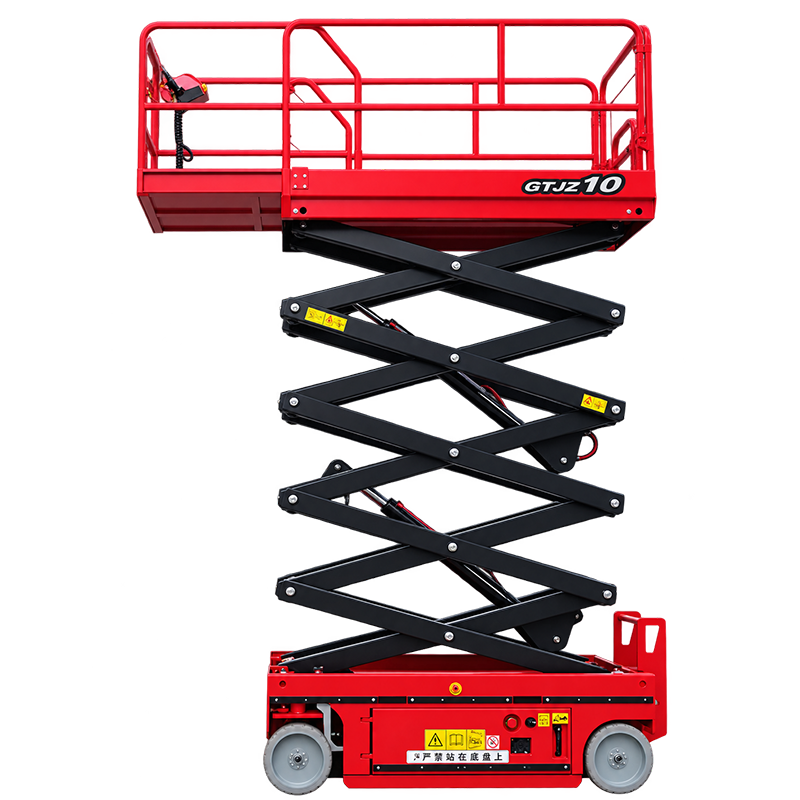
| Main Parameter | 4 m Scissor Lift | 6 m Scissor Lift | 8 m Scissor Lift | 10 m Scissor Lift | 16 m Scissor Lift |
| Model | GTJZ0407DC | GTJZ06 | GTJZ08A | GTJZ10 | GTJZ16 |
| Max. Working Height | 6.0 m | 7.8 m | 9.8 m | 11.8 m | 17.8 m |
| Max. Platform Height | 4.0 m | 5.8 m | 7.8 m | 9.8 m | 15.8 m |
| Safe Working Load | 240 kg | 230 kg | 230 kg | 320 kg | 320 kg |
| Extension Platform Capacity | 100 kg | 113 kg | 113 kg | 113 kg | 113 kg |
| Platform Size | 1.29 × 0.70 m | 1.67 × 0.74 × 1.10 m | 2.26 × 0.81 × 1.10 m | 2.29 × 1.13 × 1.10 m | 3.05 × 1.33 × 1.10 m |
| Platform Extension | 0.60 m | 0.90 m | 0.90 m | 0.90 m | 0.90 m |
| Overall Dimensions (L × W × H) | 1.48 × 0.76 × 2.00 m | 1.85 × 0.80 × 2.22 m | 2.48 × 0.84 × 2.32 m | 2.48 × 1.19 × 2.45 m | 3.25 × 1.56 × 2.70 m |
| Height with Guardrails Folded | 1.63 m | 1.85 m | 1.85 m | 1.92 m | 2.02 m |
| Wheelbase | 1.05 m | 1.36 m | 1.89 m | 1.89 m | 2.62 m |
| Drive Speed (Stowed) | 4.0 km/h | 3.5 km/h | 3.5 km/h | 3.5 km/h | 3.5 km/h |
| Gradeability | 25% | 25% | 25% | 25% | 25% |
| Lifting Motor | 24 V DC / 0.8 kW | 24 V / 3.3 kW | 24 V / 3.3 kW | 24 V / 3.3 kW | 24 V / 4.5 kW |
| Battery | 2 × 12 V / 80 Ah | 4 × 12 V / 80 Ah | 4 × 6 V / 200 Ah | 4 × 6 V / 200 Ah | 4 × 6 V |
| Machine Weight | 890 kg | Approx. 1,620 kg | Approx. 2,050 kg | 2,540 kg | 4,420 kg |
| Approximate Working Height | Typical Work Scenario |
| 6–8 m | Retail, maintenance, low-level indoor work |
| 8–10 m | Warehouse and factory maintenance |
| 10–12 m | Electrical, HVAC and industrial installation |
| 12–14 m | General construction and facility maintenance |
| 14–16 m | Industrial installation and construction |
| 16–18 m | Higher building and structural work |
| >20m | Large-scale construction and industrial projects |
Leave more about your requirements, like models, quantities, countries, etc.
An electric scissor lift uses rechargeable batteries to power the travel and lifting systems. Electric types are particularly suitable for indoor environments because they operate quietly and produce no direct engine exhaust emissions during use.
Typical operating locations include:
Many indoor electric models feature compact dimensions, tight turning radiuses and non-marking tires. These characteristics allow the machine to work in narrow aisles and move through restricted access areas.
Diesel-powered scissor lifts are generally selected when higher power, outdoor mobility and long operating periods are required. Compared with compact battery-powered units, diesel models are normally larger and capable of handling more demanding working conditions. Because of engine emissions and operating noise, diesel machines are primarily intended for outdoor or well-ventilated working areas.
A self-propelled scissor lift has an integrated drive and steering system. Operators can normally control travel, steering, lifting and lowering directly from the platform control panel. This eliminates the need to manually push the machine between working positions and makes self-propelled models particularly efficient for jobs requiring frequent repositioning. Self-propelled designs are available in both compact electric and larger outdoor configurations.
Push-around scissor lifts are compact machines designed for lighter work-at-height applications. Instead of using an onboard travel motor, the machine is repositioned manually when the platform is fully lowered.
Their compact dimensions can make them useful for:
They are generally selected when working height and platform capacity requirements are relatively low.
Leave more about your requirements, like models, quantities, countries, etc.
These two specifications should not be confused. Platform height refers to the maximum height of the platform floor. Working height estimates the height an operator can reach while standing on the platform.
Because manufacturers may calculate working height differently, please confirm both figures when comparing machines from different scissor lift suppliers.
Rated platform capacity determines the maximum permitted total load on the platform. The load may include:
For commercial purchasing, always calculate the actual expected working load instead of selecting capacity based only on the number of operators.
Platform size directly affects available working space. A larger platform can be useful when several operators or significant amounts of material need to be elevated simultaneously.
Many machines also include an extension deck that creates additional access beyond the standard platform dimensions. The main platform and extension deck may have different rated load limits.
Machine width is especially important for indoor applications. Before choosing a model, check the width of:
A machine with suitable working height but excessive chassis width may not be able to reach the intended work area.
Stowed height determines whether the machine can pass through entrances or be transported inside enclosed spaces. Some machines use folding guardrails to reduce overall transport height.
Machine weight affects transportation, floor loading and site accessibility. This specification becomes particularly important when equipment must operate on elevated floors or enter freight elevators.
Gradeability indicates the slope a machine can travel under specified conditions. It is especially relevant for outdoor equipment operating on ramps or uneven jobsites. Gradeability should not be confused with the permissible slope for raising the platform.
A smaller turning radius improves maneuverability in confined areas. This parameter is particularly important for warehouses, production facilities, narrow aisles and commercial buildings.
Depending on machine type, scissor lifts may use front-wheel drive, rear-wheel drive, two-wheel drive or four-wheel drive. Indoor electric models and outdoor rough-terrain machines have very different mobility requirements.
Leave more about your requirements, like models, quantities, countries, etc.
>> Warehousing and Logistics
Electric scissor lifts are frequently used in warehouses for:
Compact chassis dimensions and non-marking tires are often important for these applications.
>> Manufacturing Facilities
Factories use scissor lifts for installation, repair and periodic maintenance of equipment located above floor level. Applications may include production lines, ventilation systems, electrical systems, pipework and overhead infrastructure.
>> Building Construction
Construction companies use larger scissor lifts for jobs that require elevated access across relatively wide work areas. Common tasks include:
>> Commercial Building Maintenance
Shopping centers, hotels, office buildings and exhibition facilities often require periodic work on lighting, signage, ceilings and building services. Quiet electric models are normally preferred where the equipment operates around building occupants.
>> Airport and Transportation Facilities
Airports, railway stations and large logistics terminals contain extensive elevated lighting, signage, surveillance and service infrastructure. Mobile scissor lifts provide temporary elevated access without requiring permanent scaffolding.
A scissor lift is a vertically elevating work platform supported by interconnected steel arms arranged in a crossed “X” configuration. When the lifting mechanism operates, the scissor arms extend and raise the platform. When the system retracts, the platform moves downward in a controlled vertical motion.
A scissor lift does not normally provide significant horizontal outreach. Its main advantage is a relatively large work platform positioned directly above the machine chassis. This makes it especially suitable for jobs where operators need to work at height with tools, installation materials or additional personnel.
Yes. For overseas customers, ordering a basic spare parts package with the initial shipment can reduce downtime later. Recommended parts depend on the model and may include switches, sensors, seals, electrical components and other frequently replaced items.
Warranty terms vary by manufacturer and component. Buyers should ask for written clarification regarding warranty duration, covered components, exclusions and the process for handling warranty claims before placing an order.
Lead time depends on machine model, order quantity, customization requirements and current factory production schedule. Standard machines may be available faster than customized models. The final delivery schedule should be confirmed when requesting the quotation.
OEM branding is often available for distributor and fleet orders. Depending on order quantity, customization may include company logos, decals, machine colors, nameplates, manuals and packaging. Specific requirements should be provided before production.
English manuals are commonly supplied for export machines. Other language versions may be available depending on the manufacturer and order requirements. Buyers should confirm language requirements before the machines enter production.
Packing depends on machine size and shipping method. Export preparation may include protective wrapping, component protection, moisture protection and container securing. Large machines may require different loading arrangements from compact electric units.
Container quantity depends on the dimensions, weight and guardrail configuration of the selected model. Folding components may reduce shipping height for some machines. A container loading plan should therefore be calculated after the exact model and quantity are confirmed.
Not always. Controllers, drive motors, sensors, hydraulic components and structural parts may differ between models. Buyers operating a fleet should record machine model and serial information when ordering replacement parts.
This depends on the supplier’s minimum order policy. For distributors entering a new market, a trial order can be useful for evaluating machine quality, local customer acceptance and after-sales requirements before purchasing larger quantities.
Many indoor electric models can be configured with non-marking tires. This is particularly important for warehouses, shopping centers, factories and other facilities where tire marks on finished floors need to be minimized.
Support capabilities vary by supplier. International buyers should confirm whether troubleshooting can be provided through video calls, wiring diagrams, diagnostic instructions or replacement-component identification.
For an accurate quotation, provide the required working height, estimated platform load, operating environment, ground conditions, quantity, destination country and any special requirements such as battery type, charger voltage, tires or branding.