
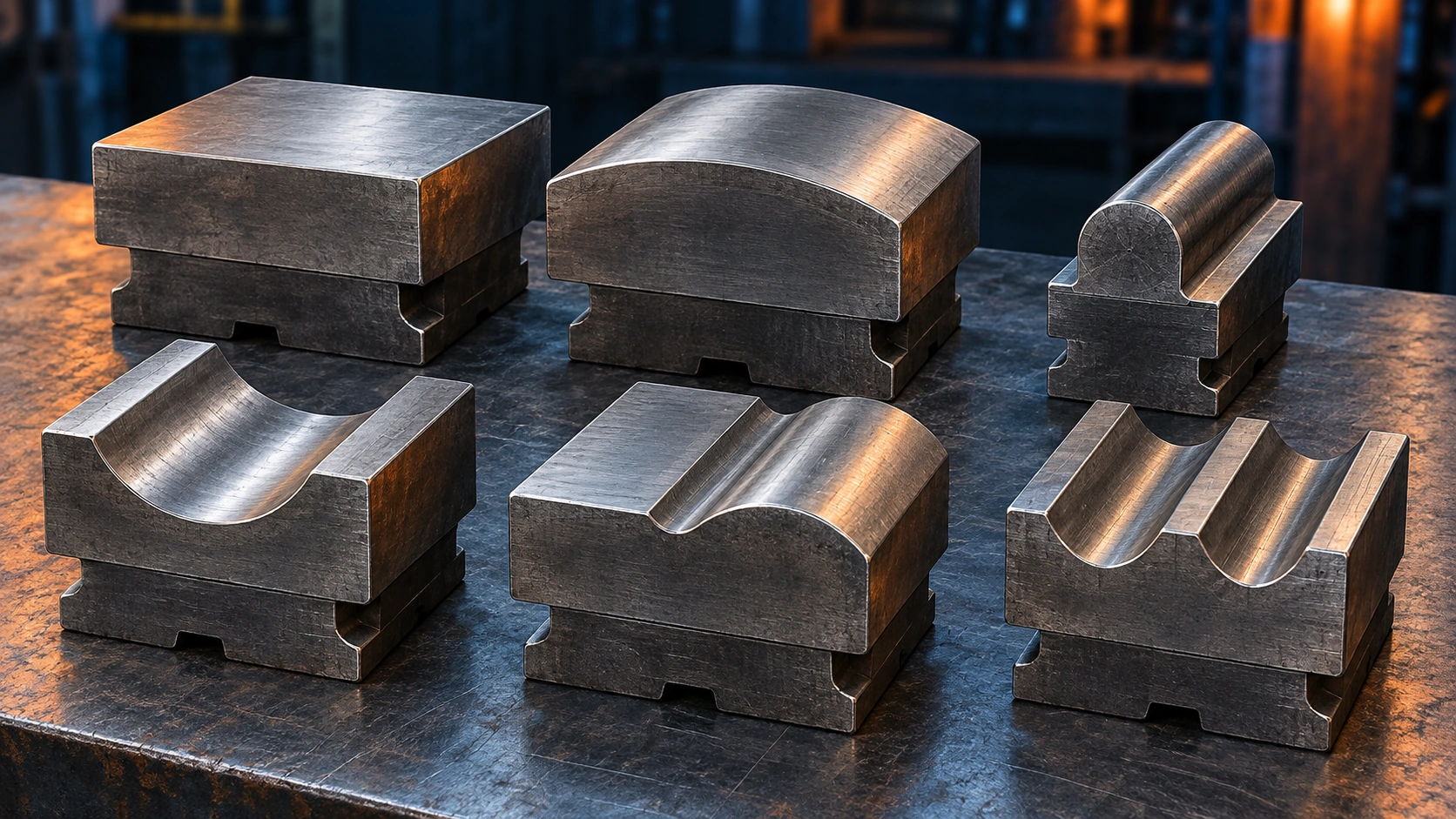
What Are Blacksmith Power Hammer Dies?
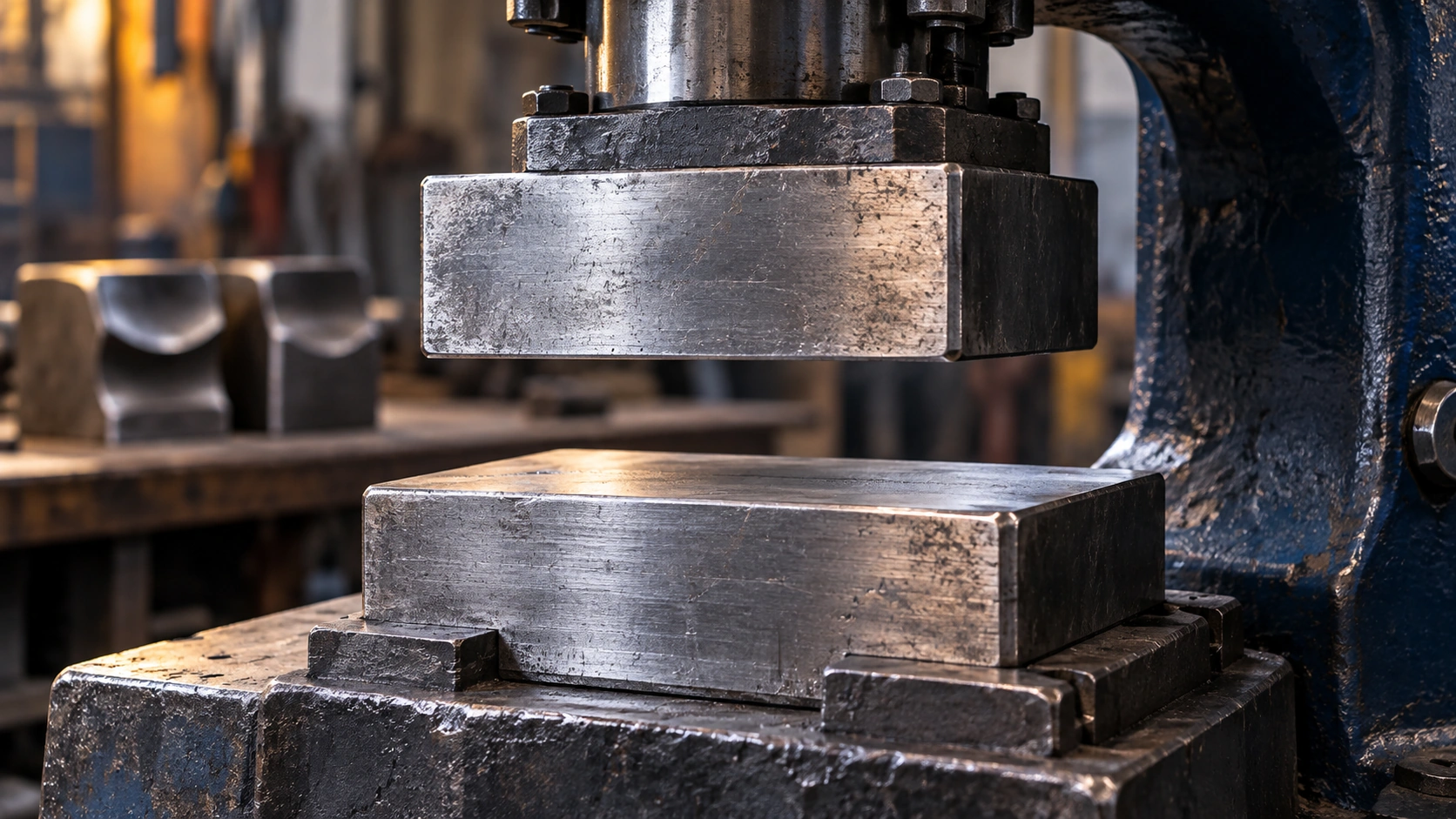
A conventional power hammer has an upper die attached to its ram and a lower die supported by the anvil assembly. During forging, the workpiece is positioned between these surfaces. Repeated blows deform the heated material.
In open-die blacksmithing, the dies do not usually enclose the whole workpiece. The operator controls the shape by feeding, rotating and repositioning the stock. Tooling and handling technique work together.
The word “die” can also describe an impression tool used in closed-die production. Fitting a shaped tool to an ordinary workshop hammer does not automatically make it suitable for industrial closed-die forging.
Why Die Geometry Matters in Hot Forging
A die's face determines its initial contact with the stock. A broad surface distributes the load differently from a narrow rounded profile. The curvature, orientation and contact area affect the local deformation.
However, the die does not determine the finished shape alone. Other factors include:
- Workpiece material and forging temperature.
- Starting dimensions and desired section.
- Blow control and workpiece positioning.
- Die alignment and surface condition.
- Available clearance and tooling access.
For example, a tool that moves material quickly during rough shaping may leave an unsuitable surface for a finishing operation. A workshop may use one profile to reduce a section and another to refine it.
Die names also vary between suppliers. “Drawing,” “fullering,” “crown” and “convex” may describe overlapping shapes.
Flat Dies: General Shaping and Surface Refinement
Flat dies have broad, substantially flat working faces. They provide a useful base for general blacksmithing, including flattening stock and developing rectangular sections. Skilled operators can also draw material with flat dies. Drawing is not exclusive to rounded tooling.
For a workshop processing varied work, a flat pair is worth evaluating before ordering several specialist profiles. It can serve as a reference surface when checking whether a billet remains square or whether a forged section needs correction.
The working face is only part of the specification. Edge radii, dimensions and mounting details also matter.
Typical Applications
- Flattening portions of blade and tool blanks.
- Refining rectangular billets.
- General open-die shaping.
- Correcting surfaces after rough deformation.
Flat dies do not guarantee a smooth finished surface. Scale, workpiece temperature, positioning and die condition still affect the result.
Drawing Dies: Reducing Sections and Extending Stock
Drawing dies commonly use rounded profiles that concentrate contact over a smaller region than broad flat faces. They are intended for operations in which a section is reduced and material is extended.
A drawing operation is useful when a workshop starts with thicker stock than the required finished section. Examples include preparing an elongated blank or reducing a portion of a bar before subsequent shaping.
Different drawing dies can behave differently. Radius and orientation should match the stock and operation. A profile suitable for rough billet reduction may be too aggressive for thin finishing work.
Typical Applications
- Drawing down bars and billets.
- Preparing elongated tool blanks.
- Reducing selected sections.
- Establishing transitions before finishing.
Fullering Dies: Localized Reduction and Transitions
Fullering tooling creates localized deformation using rounded contact surfaces. Depending on the profile and orientation, it can help establish a reduced region, move material or define a transition between sections.
For buyers, the important distinction is the required result. Do you need to extend the whole billet, isolate a section or form a controlled transition? Explain this to the tooling supplier instead of simply requesting “fuller dies.”
Typical Applications
- Isolating material for later shaping.
- Establishing necks and transitions.
- Preparing changes in cross-section.
- Localized spreading or drawing.
Fullering is not cutting. A rounded fuller is intended to displace material rather than act as a sharp cutting edge. Dedicated cutting tooling needs a separate assessment of machine suitability and operating procedure.
Crown and Convex Dies: Rounded Profiles for Versatile Shaping
Crown and convex dies have curved working faces, although suppliers use these terms differently. Some profiles provide broader rounded contact than aggressive drawing dies.
They may suit workshops that want rounded tooling for shaping while retaining a more gradual contact profile. Their usefulness depends on the actual curvature, stock dimensions and control characteristics of the hammer.
Typical Applications
- Developing tapers.
- General drawing with a rounded profile.
- Shaping curved transitions.
- Working on sections where a broad flat contact is less convenient.
Do not assume that every crown die is equivalent to every convex die. Ask for a section drawing showing the curvature and dimensions of the working surface.
Combination Dies: Two Working Profiles in One Set
Combination dies incorporate two profiles within a single die set. Common examples include drawing-and-flat or fullering-and-flat arrangements.
The practical attraction is workflow. A compatible setup may let the operator change between rough shaping and surface refinement without replacing the dies. This can be useful for mixed operations on the same workpiece.
The tradeoff is available working area. Each profile occupies only part of the face, and the transition between profiles also requires attention.
Before ordering, discuss the usable width of each section, alignment of the upper and lower profiles, and any restrictions on where blows should be applied. A combination set is not automatically preferable to separate full-width pairs.
Swage and Special Forming Tools
Swages and other shaped tools guide metal toward a particular cross-section or feature. Depending on the approved tooling arrangement, they may help form round sections, repeat selected details or establish features for later machining.
Typical Applications
- Forming selected sections on bars.
- Repeating simple features on small batches.
- Preparing blanks for subsequent machining.
- Supporting particular decorative or toolmaking operations.
A shaped groove does not guarantee final dimensional accuracy. Temperature, stock volume, positioning and subsequent processing remain relevant. Some parts need several stages and more than one tool.
Texturing Dies for Decorative Ironwork
Texturing tools create intentional surface patterns. They can be useful for artistic bars, fittings and other visible ironwork where surface character forms part of the design.
The desired texture should be assessed on a sample rather than judged only from the tool face. Stock dimensions, scale and subsequent finishing can change its appearance.
Provide a reference photograph and explain whether the texture should remain visible after brushing, grinding or coating. Also clarify where the pattern begins and ends on the workpiece.
Texturing tooling should be identified clearly and stored separately from smooth finishing dies to avoid accidental marking during another job.
Saddle Tools and Top Tools: Accessories Beyond Fixed Dies
Some power hammer systems support approved saddle tools, top tools or guided accessories. These can add operations without replacing the main fixed die pair.
They are not simply interchangeable die blocks. Their retention, support, working clearance and intended loading must be assessed as a complete arrangement.
Before using an accessory, establish whether the machine manufacturer approves it and what handling method it requires. Compatibility with the hammer's working area is only one consideration, secure positioning and operator control matter too.
Power Hammer Die Types Compared
| Die or tooling type | Main function | Example application | Key point to verify |
|---|---|---|---|
| Flat dies | Broad contact and general shaping | Flattening a tool blank | Face size, edge radii and alignment |
| Drawing dies | Section reduction and extension | Drawing down a billet | Radius, orientation and stock suitability |
| Fullering dies | Localized deformation | Establishing a transition | Profile and location of reduction |
| Crown or convex dies | Rounded contact for shaping | Developing a taper | Actual curvature, not only the name |
| Combination dies | Two profiles in one set | Rough shaping followed by refinement | Usable area and permitted loading |
| Swage or forming tools | Guiding selected features | Repeating a bar section | Stock volume, clearance and release |
| Texturing dies | Intentional surface pattern | Decorative ironwork | Sample appearance and finishing allowance |
| Approved saddle or top tools | Additional operations | Application-specific shaping | Retention, guidance and machine approval |
Checking Die Compatibility with a C41 Power Hammer
A C41 designation alone is not a complete tooling specification. Similar model names or nominal hammer weights do not prove that dies from different manufacturers will fit.
Check the mounting interface, overall dimensions and working height. Depending on the design, the interface may involve dovetails, keys, wedges, bolts or a particular holder.
Provide the power hammer suppliers with:
- Manufacturer, model and machine serial number where available.
- Photographs of both existing dies and their mounts.
- Dimensioned drawings of the mounting interfaces.
- Current die height and available working clearance.
- Material and stock dimensions.
- Desired tooling profile and intended operation.
Do not force a die into place or improvise its retention to compensate for a mismatch. Obtain confirmation for the exact assembly.
Die Material, Heat Treatment and Service Conditions
Power hammer tooling experiences repeated impact and contact with hot stock. Suitable performance depends on the material, heat treatment, geometry and working conditions together.
Maximum hardness is not the only objective. Tooling also needs adequate toughness for its service. A material name without heat-treatment information gives an incomplete picture of the supplied die.
Ask for the specified steel grade, treatment condition and any operating requirements, including preheating where prescribed. Do not apply a temperature or hardness recommendation from another product without confirmation.
Avoid describing a die as “wear-proof” or assigning a guaranteed service life without supporting information. Stock condition, use and maintenance affect wear.
Discussing Power Hammer Tooling with Guigong Machinery
A useful tooling discussion begins with the part you need to make. Send the material grade, stock dimensions, target shape and photographs or drawings of the existing setup.
For a new machine enquiry, specify the operations you want to perform and ask which dies are included in the quoted configuration. For an existing machine, provide mounting measurements before discussing replacement tooling.
Visit the Guigong Machinery blacksmith power hammer product page to submit your requirements. Confirm tooling availability and model compatibility as part of the quotation.
Explore Blacksmith Power HammersFAQs About Blacksmith Power Hammer Dies
1. What are power hammer dies used for?
Power hammer dies contact the heated workpiece and influence its deformation under repeated blows. Different profiles support flattening, drawing, fullering, forming or texturing. The finished result also depends on stock temperature, positioning and operator control. Dies should match both the intended operation and the machine's mounting arrangement.
2. What is the difference between flat dies and drawing dies?
Flat dies provide broad working faces for general shaping and surface refinement. Drawing dies usually have rounded profiles with more concentrated contact for reducing sections and extending stock. Flat dies can also draw material in skilled hands, so the distinction concerns geometry and workflow rather than an exclusive capability.
3. Are drawing dies and fullering dies the same?
Their functions can overlap, and suppliers use the names differently. Drawing dies generally emphasize extending material, while fullering tools often establish localized reductions or transitions. Compare the working radius, orientation and profile drawing. Explain the required workpiece shape rather than ordering solely by the advertised die name.
4. What are combination power hammer dies?
Combination dies place two working profiles, such as drawing and flat sections, within one set. They can reduce changes between compatible operations. However, each section offers less working area than a dedicated full-width die. Check upper-to-lower alignment, usable face dimensions and the machine's restrictions on loading position.
5. Are all C41 power hammer dies interchangeable?
No. A shared C41 designation or nominal hammer weight does not establish compatibility. Manufacturers may use different mounts, dimensions and working heights. Provide the exact model, photographs and measured mounting details. Obtain supplier confirmation before ordering replacements rather than assuming dies from another C41 machine will fit correctly.
6. Can hydraulic press dies be used on a power hammer?
Not automatically. A hydraulic press and a power hammer apply different loading conditions, and their tooling mounts may differ. A die designed for pressing may be unsuitable for repeated impacts. Confirm material, heat treatment, retention and machine approval before considering shared tooling, even when the working profiles look similar.
7. What steel should power hammer dies be made from?
The suitable grade depends on the tooling design and service conditions. Material selection must balance impact toughness, wear resistance and hot-working requirements. Heat treatment is equally important. Ask the supplier for the complete specification rather than choosing by hardness alone or treating different tool-steel grades as direct substitutes.
8. Do power hammer dies need preheating?
Some tooling requires preheating before service, but the requirement depends on material, treatment and manufacturer instructions. There is no universal temperature for every die. Obtain the procedure for your supplied tooling and follow it consistently.
9. How often should power hammer dies be replaced?
Replacement depends on condition rather than a universal timetable. Inspect for cracking, chipping, insecure retention and unacceptable profile wear according to the manufacturer's instructions. Workload, material and operating conditions affect life. Stop using damaged tooling and obtain an assessment when its continued suitability or repairability is uncertain.
10. Can one die set perform every forging operation?
A general-purpose set can cover many tasks, particularly with experienced handling, but it does not suit every feature or stock size. Specialized operations may need different profiles or approved accessories. Select additional tooling around recurring production needs instead of expecting one pair to provide every shape and finish.
11. Can I grind a different shape into existing dies?
Reprofiling may be possible for some dies, but it requires approval and an understanding of their construction. Grinding can change clearance, alignment and heat-treated surfaces. Supply the proposed drawing to the tooling manufacturer first. Do not assume an apparently solid die has uniform hardness or sufficient remaining material.
12. Can shaped dies turn my hammer into a closed-die forging machine?
Not by themselves. Closed-die forging requires suitable equipment, tooling, stock preparation and process control. An impression tool on an ordinary workshop hammer does not establish those capabilities. Discuss the complete part and production requirement with the equipment supplier before attempting operations beyond the machine's intended open-die applications.